The pompous funeral of Federal Chancellor Konrad Adenauer went down in history as one of the great funerals of the 20th century, with TV broadcasts as far away as Japan and the USA. The most important Western representatives came to the Rhine for Adenauer’s funeral service on 25 April 1967. Even two politicians who at the time were only distantly related, US President Lyndon B. Johnson and French President Charles de Gaulle, finally shook hands. Representatives of the Eastern Bloc did not attend the funeral, only the Soviet Union sent its ambassador from Bonn – the Cold War was not yet ready for a meeting of East and West and for more détente in the world. This was to change 13 years later at a “working funeral” as the meeting place for quiet diplomacy in the Cold War: the “working funeral” in Belgrade.
Yugoslavia’s Third Way
On 4 May 1980, Yugoslavia’s President Josip Broz Tito died in Ljubljana. His death at the age of 88 was foreseeable after a serious illness and marked the end of an era. He was, as Die Zeit called him, the “last Habsburg”, who achieved the feat of forming a communist-capitalist state from the Austro-Hungarian legacy and ruling it as a non-aligned country between East and West. Through Tito’s authority, Yugoslavia existed as a successor to the multi-ethnic state with diverging interests and declining living standards from north-west to south-east. Tito was the integrating figure of the Slovenes, Croats, Serbs, Bosniaks, Macedonians, Montenegrins and Kosovars.
Yugoslavia took on a special role after the Second World War: The “Iron Curtain” did not pass through this socialist federal republic (SFRY). It resisted Soviet hegemonic policy and did not seek unconditional alignment with the West, but instead defined a Third Way under the leadership of the Communist Party of Yugoslavia, i.e. a mild socialism between Moscow communism and Western capitalism, economically speaking with less central state control in favour of workers’ self-management. The Yugoslav economy flourished from the 1960s onwards thanks to generous loans from Western countries and the International Monetary Fund, but ended up in national debt and financial dependence in the 1970s. In terms of foreign policy, Tito positioned the country within the non-aligned states from 1961 onwards.
But what came after Tito, who had cultivated a luxurious lifestyle and promoted the personality cult surrounding him “between professional revolutionary and grand seigneur"? There was no established successor. Towards the end of his era, nationalism gained momentum. After his death, a collective leadership with a rotation of offices and distributed nationalities was to run the government.
Conflicts and wars characterise the period
In 1980, there were major tensions between East and West. As early as January 1979, the heads of government of the USA, Great Britain, France and the Federal Republic of Germany had decided to no longer support Shah Pahlavi of Persia in favour of Ayatollah Khomeini. In doing so, they paved the way for an Islamic Republic of Iran. The hostage-taking at the US embassy in Tehran had kept politicians on tenterhooks since November. The Soviet Union invaded Afghanistan with its troops in December 1979 to support the new communist government. Meanwhile, the USA provided military aid to the mujahideen, and proxy wars dominated the situation in the Middle East. Critics even labelled Yugoslavia, led by a president in poor health, as an unstable, fragile country that had failed after 35 years. A meeting of leading heads of government for informal talks on war and peace was urgently needed. This opportunity arose at Tito’s funeral in May 1980.
“There should be a funeral like this every year”
This is how Der Spiegel quoted Helmut Schmidt in Belgrade. According to Tagesschau on 8 May, representatives from 115 countries came together, other sources spoke of 121 to 127 countries, Jimmy Carter, Valéry Giscard d’Estaing and Fidel Castro were missing. Albania sent its ambassador. The funeral was broadcast live on television in 40 countries. Around half a million people are said to have travelled to Belgrade to pay their last respects to Tito. It was the largest international gathering of mourners during a critical phase of confrontation between East and West.
Arriving at the Inter-Continental Hotel in Belgrade in the evening after a long journey, Margret Thatcher was Schmidt’s first dialogue partner. The Chancellor took advantage of the two days to hold further intensive bilateral talks; ten major talks and a large number of smaller ones were organised for him. Tito’s death brought almost the entire political elite of 1980 together in one place: Vice President Walter Mondale represented the USA.
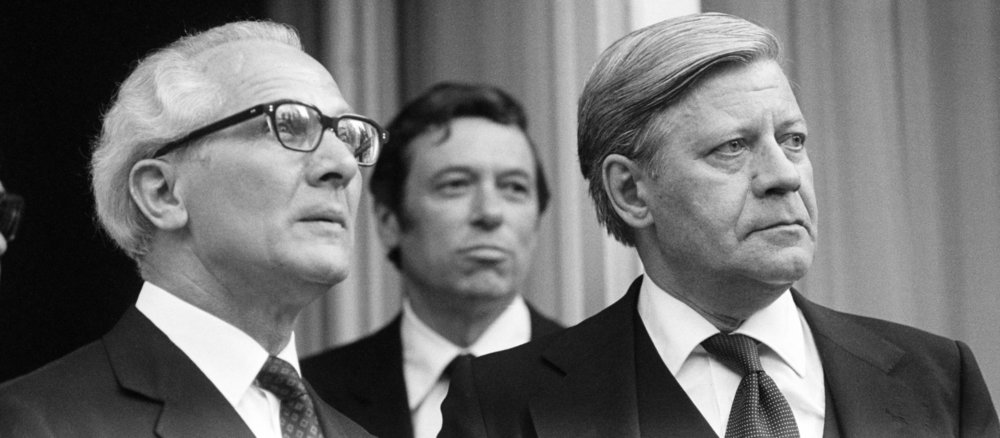
As with Adenauer’s funeral, it was referred to as a “working funeral”. It was the time and place for informal diplomacy. At the German-German level, both heads of government sought further rapprochement in the Federal Republic’s residence in Belgrade. Honecker and Schmidt had not met since the Helsinki Conference in 1975, but had spoken regularly on the phone. The first German-German meeting in five years lasted 78 minutes and it was agreed in the interests of both sides not to escalate the confrontations any further, but to promote a dialogue of détente between the superpowers USA and USSR and to keep the channels of dialogue open. Honecker and the Polish party leader Edward Gierek expressly encouraged Schmidt to embark on his planned trip to Moscow in the summer of 1980 in the spirit of détente and, at best, disarmament talks with CPSU leader Brezhnev. At the same time, Thatcher and Schmidt threatened to boycott the Summer Olympics in Moscow and impose sanctions on Iran if the Soviet Union did not withdraw from Afghanistan. The boycott of the Olympics was particularly painful for Brezhnev, but also for Honecker. The desire of the Eastern Bloc states to demonstrate the superiority of sporting socialism to the West in 1980 came to nothing.
In his letter of condolence, Schmidt expressed his confidence to the Yugoslavian government that Tito’s work would endure beyond his death. Through his work, the country had become “a united, independent country capable of great achievements”. “The Federal Government is prepared to help ensure that this work can be continued.”
After Tito’s death, the President of the Federal Executive Council and Prime Minister of Yugoslavia, Veselin Đuranović, visited the Federal Republic of Germany in 1981. After his speech at the dinner in Palais Schaumburg, Helmut Schmidt raised a glass to “the further, mutually fruitful development of cooperation” and “the friendship between our peoples; to a peaceful and prosperous future for Yugoslavia”. Things turned out differently. A decade later, at the beginning of the 1990s, the socialist social order disintegrated and the Eastern Bloc states, once under the hegemony of Moscow, embarked on seemingly peaceful paths into a new era modelled on capitalist democracies. Only Yugoslavia disintegrated into its individual states during relentless wars. Ten years after Tito’s death, the different ethnicities, religions and unequal economies of the constituent republics caused the coexistence of the population to break down.
Five dilemmas and three options
In 1994, during the Yugoslav Wars, Helmut Schmidt recalled the evening in Belgrade in May 1980 in the midst of other Western heads of government: how long would the “artificial state” last, when would the conflicts break out? Schmidt saw a mistake in the diplomatic recognition of republics declaring themselves sovereign without binding declarations of non-violence. Schmidt recognised five dilemmas: the West shied away from deploying its own troops to defuse the conflict. Moscow was not involved in conflict containment and Russia was also excluded from summit meetings of major industrialised nations. There was no concept for effective aid for Bosnian Muslims. Future conflict regions, for example between Greece and Macedonia, were carelessly perceived. There was a lack of standardised asylum and immigration legislation and practice to regulate additional refugee movements in the EU: the main destination would remain Germany.
In order to maintain lasting peace, Schmidt saw a first solution option, the West would have to station at least 100,000 soldiers in the former Yugoslavia. However, neither the electorate in the Western states nor Russia would accept this. The second option would be to use economic and military means on a case-by-case basis to contain future conflicts. A laissez-faire approach – the third option – would have ignored morality and human rights.
The country of Yugoslavia is now history. Its people had to seek a long, painful path to peaceful coexistence, which will hopefully be completed in the next generation.