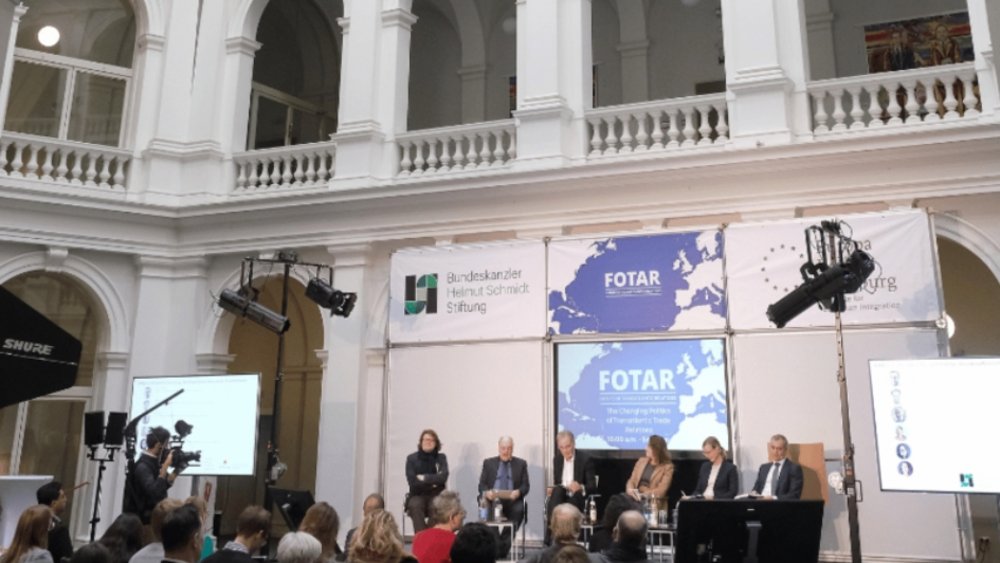

The concept of “change through trade”, long popular in German foreign policy, has proven to be naive in today’s political context with Russia's war of aggression against Ukraine.
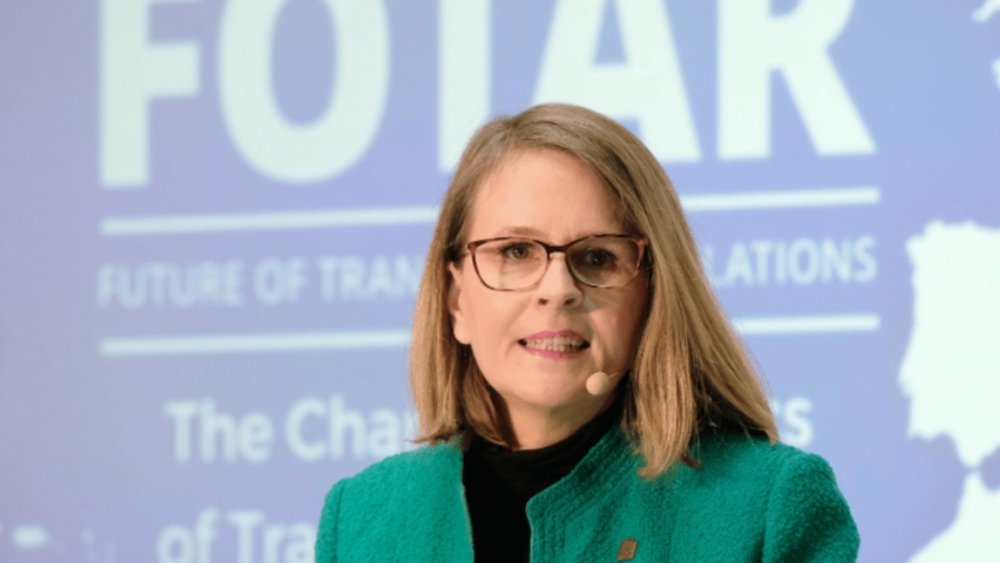
However, the economic policy challenges do not end with Russia’s war of aggression. Rather, they are just the beginning. “Ukraine is the tsunami and China is climate change.” – this is how the Economist quotes a US diplomat. With these words, our FOTAR keynote speaker Malin Oud appealed to the transatlantic partners to consider the political dimension of their international trade policy. She emphasised that the EU and the USA must stand up for the protection of human rights, especially in global supply chains.
After all, trade does not automatically lead to change. In a globalised world, the close connection between business and politics must be taken into account so that the intertwined economic relationships do not turn out to be critical dependencies in times of crisis. As former EU Commission President Jean-Claude Juncker said: “We are no naive traders.”. Following this realisation, an active EU-US trade policy is needed to meet the political challenges. Building on the discussions at FOTAR, concrete recommendations for action can be formulated for a transatlantic trade agenda.
Strengthening the transatlantic trade partnership
After former US President Donald Trump largely brought transatlantic trade relations with the EU to a standstill, it is now up to his successor Joe Biden to revitalise them. The import tariffs imposed by Trump against the EU have already been abolished and, in turn, the measures imposed by the EU have also been terminated.
The TTC (Trade and Technology Council) now provides a good basis for rapprochement and closer cooperation. The forum for coordinating the transatlantic trade strategy was founded in June 2021 and has met three times since then. At the last meeting in December 2022, the need for a Mutual Recognition Agreement was identified. Such an agreement regulates the mutual recognition of different standards, for example in the food industry. The aim is therefore to facilitate joint trade.
The possibility of a transatlantic free trade agreement could also be explored as part of the TTC. However, the negotiations on TTIP (Transatlantic Trade and Investment Partnership) were not only brought to a complete halt by Donald Trump; there were also doubts in the EU about its political feasibility. Concerns about falling social, environmental and consumer standards as well as a weakening of democratic institutions led to large-scale demonstrations against the agreement.
A simple resumption of negotiations is therefore unrealistic. However, with President Joe Biden as a convinced transatlanticist, the EU could receive an impetus for more economic integration and restore the damaged trust.
Furthermore, cooperation between the USA and the EU in the already crisis-ridden WTO (World Trade Organisation) remains limited. The USA is still blocking the WTO’s dispute settlement procedure, despite the fact that the EU, together with other partners such as Canada, has already submitted concrete proposals. An agreement in favour of a joint transatlantic solution would therefore be a strong signal for a multilateral trade order of the future.
Exploring further trade relations
Another challenge in transatlantic cooperation is the political differences with other major economic powers – above all China. China has been repeatedly criticised for human rights violations. Most recently, the EU sanctioned Chinese government officials for oppressing the Muslim Uyghur minority. For this reason, no official representatives of the US government travelled to Beijing for the Olympic Games.
In order to become less economically dependent on China, the transatlantic partners should expand their trade relations with other economic nations. But which countries could be trustworthy trading partners in the future in order to reduce critical dependencies on the EU and the USA?
Increased investment by European and US companies in Southeast Asia can already be observed. Foreign direct investment from the US has increased by an average of ten per cent annually over the last decade, and the EU was the third largest investor in Southeast Asia in 2019.
With the exception of the agreements that both the EU and the US have with Singapore and an EU-Vietnam free trade agreement, trade and investment agreements in Southeast Asia have so far been difficult for the EU and the US to finalise. The most effective approach here would be to conduct negotiations directly with the Association of Southeast Asian Nations (ASEAN). Trade agreements with ASEAN, in response to the growing investments in the region, would diversify the trade partnerships of the EU and the USA and thus reduce the influence of China and Russia. However, special attention must also be paid to respecting human rights in negotiations with ASEAN.
A transatlantic investment policy
International trade is closely linked to foreign direct investment. However, this can lead to certain risks, for example through political action by the foreign government. Investments from China are repeatedly mentioned in this context. Europe and the USA have been the main destinations for Chinese direct investment for the last two decades. However, despite political concerns on both sides of the Atlantic, there is a lack of a common agenda in investment policy.
The EU and the US have negotiated or concluded unilateral agreements with China. In order to avoid critical dependencies, both should refrain from concluding investment and trade agreements with China in future – especially if these are only pursued unilaterally rather than as part of transatlantic cooperation.
In order to be able to screen foreign direct investments, especially from China, more effectively for security risks in future, transatlantic coordination in investment screening is required. While investment screening has a long tradition in the USA, the EU is currently still struggling to establish standardised and binding investment screening. The current cooperation in the TTC can be a good starting point for stronger transatlantic cooperation and standardisation within the EU.
The idea that trade automatically brings about political change has clearly overestimated the potential of economic integration. Active trade policy is different: it can exert political influence. Given the political challenges facing the rules-based global economic system, it is time for a transatlantic trade policy agenda.