
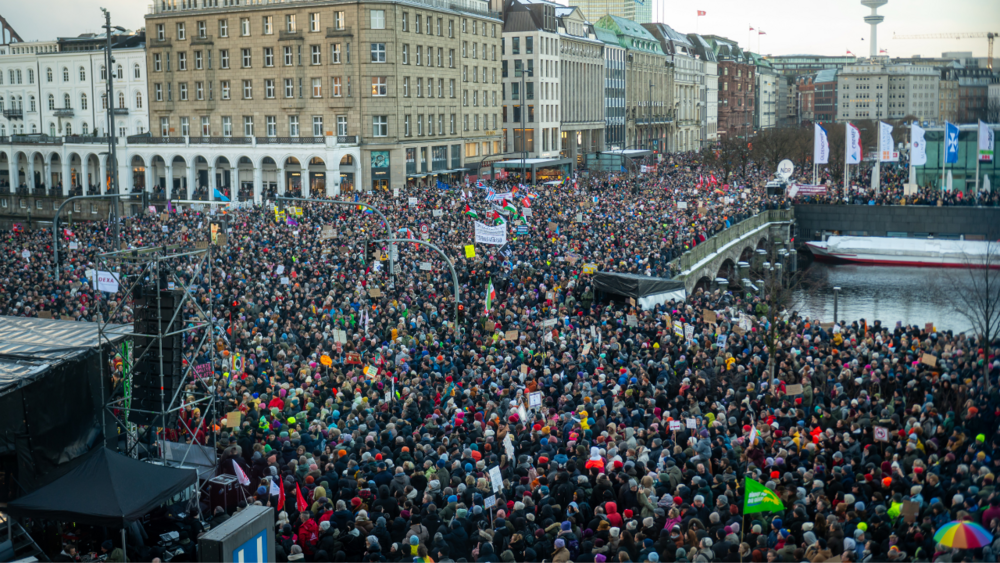
Tens of thousands of protesters pushed their way through Hamburg's city centre over the past few weekends. More than for a long time. The slogan "We are more!" of the pro-democracy and anti-racist alliances at the mass demonstrations against right-wing extremism was not only expressed verbally, but also visually. Several million people took part in the demonstrations across Germany. The protest generated powerful images that show the dynamism with which people can be mobilised for democracy. The number of posts shared on social media under the hashtags #DemoGegenRechts or #DeutschlandStehtAuf skyrocketed. Politicians and celebrities took part in the rallies and showed themselves to be part of the protest movement on their social media profiles. In some cities, there was even a competition to see who would bring more people onto the streets - Hamburg, Munich, Cologne or Berlin?
In the aftermath, right-wing actors attempted to discredit the success of the demonstrations by claiming that some of the images were fakes generated by artificial intelligence. However, these false claims were easy to debunk, as a fact check by the Tagesschau news programme shows. Although the right-wing populist narrative that the "silent majority" of society shares their positions was subsequently tarnished, the refutations had little effect within their own right-wing populist filter bubbles. The alleged evidence of image manipulation continued to be shared on social media channels.
The initiators of the pro-democracy protests nevertheless felt vindicated: the images show it - there are more of us! At the same time, they called for more than just symbolism and strong images. The competition for the most original posters, the most crowded city centres or the coolest "demo day outfits" - in short, the best pictures - was also criticised.
Battlefields of interpretative power
These examples show: Today, images are one of the most important tools for mobilising people and influencing political opinion. This means that images can also repeatedly create facts and become the starting point for battles over the power of interpretation. This power makes images susceptible to instrumentalisation and manipulation. At the same time, the role of the credibility of images is constantly being renegotiated. What is considered authentic? When do they serve as evidence for facts, when is it more about a good narrative? The step towards trivialising political content in the competition for the best image is often not a big one.
One thing is certain: Images are a strong political currency. If you want to do politics, you need images. This applies to forces that threaten parliamentary democracy as well as those that protect it.
A look back at the "century of images" provides insights into the interplay between democracy and its images and answers the question of why it is often worth looking twice.
Images for the imageless?
Illustrating democracy is a challenge because, in contrast to other forms of rule, it is imageless in its idea: "Democracy has no monuments. It does not mint medals. It bears no man's head on a coin," stated US President John Quincy Adams in 1831. Even if this is no longer entirely true, especially today, Adams' statement points to a central challenge of democracy: through visual restraint, it loses an enormous potential for identification and emotionalisation. This is a problem that anti-democratic forces and ideologies rarely have. They do not shy away from the mass use of imagery and pathetic symbols that are often characterised by nationalist aesthetics. The fight against this flood of images is a challenge for pro-democratic lobbying. Although the federal governments have repeatedly endeavoured to create positive images and symbols, and there are also monuments, it is obviously difficult to find supporting motifs. Today, not even the original document of the Basic Law is on public display, thus forgoing a considerable part of its appeal. As a result, the engine room of democracy often appears dull, with the grey backs of files and the blue of the Bundestag hardly arousing any enthusiasm.
Between sobriety and new radiance
The founding of the Federal Republic of Germany begins in a visually restrained manner. After the end of the war, the Bonn Republic endeavoured to distance itself from National Socialist visual theatrics and was cautious in its use of national symbols. Erna Wagner-Hehmke's well-known, newly objective photographs of the signing of the Basic Law in May 1949 symbolise this style. This visual restraint may have been well received internationally, but these images lacked the power to make an impact domestically. Here it was the images of consumption and the economic miracle, of the millionth VW Beetle, which were not only intended to reflect the success of the social market economy, but were also positively associated with democracy by the population.
Over the decades, the visual language of politics became more differentiated and problem-focussed. Photographic "home stories" from the Federal Chancellery or an image campaign by Willy Brandt's government in 1970 with photographs by the well-known advertising photographer Charles Wilp show the increased attention that politicians and voters paid to visuals. However, with the broadening of the media landscape and the increasing accessibility of media public spaces, politics also had to be measured against the changing and growing communicative demands of the population.
Helmut Schmidt and the media
Helmut Schmidt also knew how to utilise the effect of images and symbols to convey his political messages - and not just since his chancellorship. As early as the 1957 Bundestag elections, Schmidt had an election advert produced in which he could be seen with his family, following the American model. Schmidt always knew how to appeal to Hamburg voters in particular, for example during his appearance at the opening of the Elbe tunnel in 1975, complete with his typical pilot's cap. He always presented himself in a hands-on and fact-orientated manner. He played a decisive role in shaping the visual self-image of the young Federal Republic.
During his time in office as Federal Chancellor, Schmidt was confronted with visually powerful events: Anti-nuclear and peace protests or RAF terrorism. His responses often had to include not only political but also communicative solutions in order to react appropriately to the images of conflicts and crises.
Schmidt was able to counter the images of violence caused by the RAF with his matter-of-fact appearance and clear language in his television address on 5 September 1977. Many saw the strength of the democratic constitutional state credibly presented in the television images.
However, Schmidt's communication was not always so successful. While the anti-nuclear protests and the demonstrations of the peace movement drove hundreds of thousands of people onto the streets and communicated with colourful, creative images, Helmut Schmidt and the German government found it difficult to reach them with both their arguments and their sober visual language. The government was also unable to dispel the fear of an anti-democratic "nuclear state" among many opponents of nuclear power. The images of heavily armed policemen guarding construction sites spoke a different language for them.
New themed tour in our exhibition
Since Helmut Schmidt's time in office, the importance of images has steadily increased. This is true for political actors, but also for democracy itself, which is constantly coming under pressure in times of crisis. What images do politicians and civil society initiatives choose today to promote democracy, and what visual challenges do they face as a result of social media?
We would like to discuss this with you on our new themed tour "Democracy in the picture. Helmut Schmidt and the media" in our exhibition and ask together which images are actually made by whom, for whom and with what intention.
The themed tour will take place every Sunday at 16:00 in our exhibition at the Helmut Schmidt Forum in Hamburg from February 2024 and is free of charge. Registration is not required. You can book private group tours at