
Building peace without weapons? Protest is experiencing a turning point
09. Apr 2022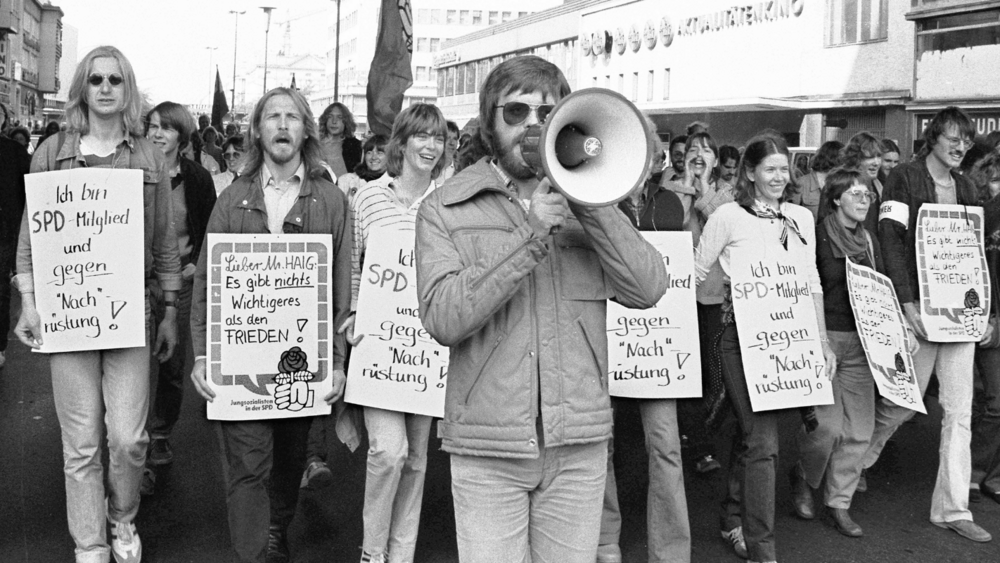
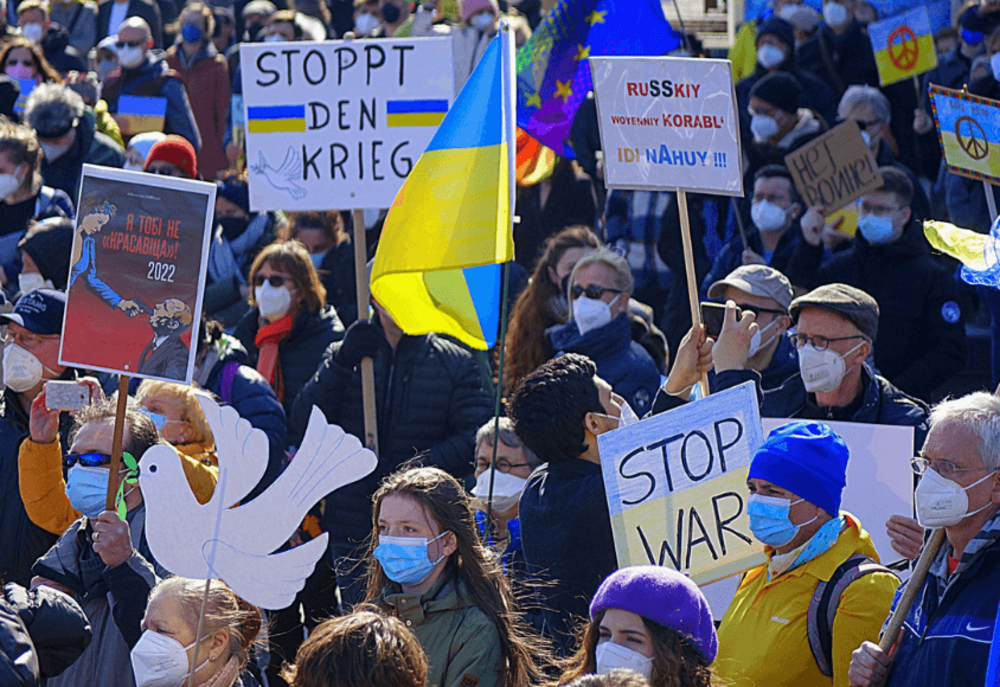
They hold up posters with a white dove, some shout "stop the war", others wave blue and yellow flags. With symbols such as the dove of peace or the peace sign of the British Campaign for Nuclear Disarmament, the protesters are harking back to earlier times. Since the start of the Russian war of aggression against Ukraine on 24 February 2022, people have been demonstrating for peace in larger numbers again. In Berlin alone, more than 100,000 peace activists took to the streets. The fact that people are publicly committed to peace is almost a continuity in the history of protest in Germany. What is new, however, is that the peace movement's earlier demand from the 1980s "Creating peace without weapons" no longer seems to be generally valid and the demonstrations are no longer directed against the governments of the Federal Republic of Germany and the United States.
Demonstrations for peace in 2022
Speakers at the Brandenburg Gate ask "Do you want war?" and the crowd answers loudly "We want peace". On 27 February this year, a broad alliance called for a large demonstration there under the title "Europe of Disarmament, Détente and Understanding". According to the police, around 100,000 people took part, with the organisers themselves claiming 500,000 participants. One day later, on Rose Monday, carnival clubs in Cologne followed suit. Under the motto "Mir sin all nur Minsche" (We are all just people), between 150,000 and 250,000 costumed and non-costumed people took to the streets with self-made figures of Putin, who was pilloried as a warmonger. On 5 March, around a week after the start of the war, the mobilisation reached its peak: the largest rally in Germany took place in Hamburg, and across Europein Rome. This was followed by calls from schoolchildren in small towns, the musical peace demonstration "Sound of Peace" in Berlin and hoisted Ukrainian national flags in front of theatres, from church steeples or in allotment garden associations. Even in Moscow and St. Petersburg, despite massive police presence and threats of punishment, several thousand people took to the streets, many of whom were arrested.
#Peace - The media bring the war straight home
Russia's invasion of Ukraine has triggered a new mobilisation and great solidarity that we have not seen in other wars. It is the first war of aggression between states in the narrower sense to take place in Europe itself since 1945, even though European governments have been and continue to be involved in wars. In addition to the geographical proximity and the impression that we as a country are politically involved, the constant reporting of conventional media, but also the communication of recorded images and videos of those affected from the war zones themselves, contribute to this. These impressions and stories of the people bring the war directly home and give the abstract horror tangible faces and stories. Renowned protest researcher Dieter Rucht from the Institute for Protest and Movement Research in Berlin aptly describes the phenomenon in an interview: "You have the feeling that you are sitting among the people. [...] That creates an immediate sense of involvement, unlike back in Vietnam". This comparison with earlier mobilisations is obvious, as people have been taking to the streets in the form of mass demonstrations for peace in Germany alone since the First World War.
Older, newer, newest peace movement?
When people talk about the earlier peace movements today, they primarily associate them with the mobilisations in the course of the "new social movements" in the 1970s and early 1980s. Elfriede ("Friedel") Grützmacher is one person who was involved back then and is still protesting for peace today. In the early 1980s, convoys of American Pershing II missiles travelled from Mutlangen to the base in the Palatinate Forest near her home in Wörth. Friedel Grützmacher blocked the convoys with others, clashed with local politicians, mobilised neighbours and years later became a member of the Rhineland-Palatinate state parliament for the Greens - her biography thus also reflects a form of overlap between environmental and peace engagement and their institutionalisation. When asked who was committed to peace at the time, the link between energy issues and peace policy immediately becomes clear. According to Friedel Grützmacher, the groups that campaigned for peace and disarmament were almost identical to those that spoke out against nuclear power. After all, nuclear power plants are needed to produce weapons-grade uranium, so the protests were directed against the civilian and military use of nuclear energy. To this day, the resulting mobilisations for large-scale demonstrations are numerically the most successful in the history of the Federal Republic of Germany.
With this first linking of peace and environmental issues, the "newer" peace movement laid the foundation for a common framing that still enables alliances with climate activists today. The broad mobilisation base of Fridays for Future and the institutionally consolidated environmental organisations contributes significantly to the successful mobilisations for peace. In contrast to the environmental movement, from which influential organisations such as BUND and Greenpeace emerged, this institutionalisation largely failed to materialise when it came to peace. Instead, broad alliances of a large number of organisations mobilise for peace. Trade unions, environmental groups, campaign networks, church organisations, social associations and often also political parties come together on an ad hoc basis. As in the case of the mobilisation against the war in Ukraine, they are united by a kind of minimal consensus to be for peace and against war. Dieter Rucht sees this as a key difference to the "new social movements", some of which questioned the political order and parliamentary democracy as a whole. In his view, we have not (yet) seen a new peace movement, but so far only a political campaign that largely coincides with the stance of the government itself.
Government as friend or foe
That was different in 1981. When Helmut Schmidt spoke at the Protestant Church Congress in Hamburg, there were protests outside the venue against his planned nuclear "rearmament". The new social movements sharply criticised government policy, above all the NATO dual-track decision. Schmidt's adherence to the policy of deterrence led to social as well as internal party tensions, which contributed significantly to the end of the social-liberal coalition in 1982. When asked about allies in established politics in the 1980s, Grützmacher emphasises: "We did it outside of politics because there was no resonance in politics at all". The current coalition government, on the other hand, strongly condemns Russia's invasion. It is therefore not surprising that the tactics differ from those used back then: For example, the current peace protests have so far not shown any forms of civil disobedience such as sit-in blockades, which have become part of the protest repertoire in the Federal Republic, not least due to the "new social movements". However, Dieter Rucht emphasises that "it is unusual, but not unique, for peace demonstrators to agree with the government's stance". This had already been observed in 2003 with the No to the Iraq war.
In addition to the positioning towards the government, the political context was also different: since the end of the 1970s, peace protesters had been accused of having an anti-American stance by the German government and large sections of the population because they were against the deployment of American missiles. This ultimately formed the basis for the "Krefeld Appeal", in which more than four million German citizens spoke out against the "rearmament" favoured by the Schmidt government. This was followed by the "Bielefeld Appeal" by SPD politicians to distance themselves from communist groups and the accusation of a pro-Russian stance. Although the current bloc confrontation of "the West" against Russia is reminiscent of that time, many of the protesters' demands today are explicitly directed against the Russian government.
A turning point in the understanding of peace?
Since the demands for arms deliveries by the Ukrainian government and civil society, the inherent contradiction between demonstrating against war and advocating unilateral military support has become apparent. At the beginning of the peace demonstrations in February, this disagreement already led to the separate mobilisation of the Ukrainian diaspora organisation Vitsche, which called for early deliveries of weapons. The speeches given at the main demonstration nevertheless revealed disagreement among the demonstrators, with clear demands for the Ukrainian armed forces to be equipped and those who, as pacifists, were fundamentally opposed to arms deliveries, as well as those who sharply criticised the high sum of 100 billion euros. In the meantime, many consider the German government's decision to supply arms to be a necessary measure to stop the war: In a recent survey by Civey, for example, two thirds of respondents in Germany supported this decision. At the same time, critical voices are also becoming louder at the demonstrations as to whether the 100 billion for a "special Bundeswehr fund" is justified. Recently, #DerAppell "Demokratie und Sozialstaat bewahren - Keine Hochrüstung ins Grundgesetz!" was published, initiated by voices from the SPD, the Left and academia. It is striking that hardly any Green groups and MPs support this appeal, which clearly opposes additional funding for the Bundeswehr. These examples show the minimal consensus to stand up for peace - but at the same time the disagreement on the details of how we create peace. The minimal consensus of wanting to help and stop the war is still masking major divisions within the Greens and their affiliated civil society organisations. Only after the acute moment will it become clear whether these disputes mark the beginning of a new era of peace demonstrations in Germany.

Until August 2022, Dr Nina-Kathrin Wienkoop was head of the "Democracy and Society" programme line. She is associated with the Berlin Institute for Protest and Movement Research and the German Centre for Integration and Migration Research. At the latter, she previously headed a research project on participation in youth engagement. She publishes, advises, researches and teaches on topics such as the resilience of democracies, domestic and international democracy promotion, youth engagement, non-violent resistance, diversity and protests, debate culture and diversity-conscious organisational development in civil society.
More