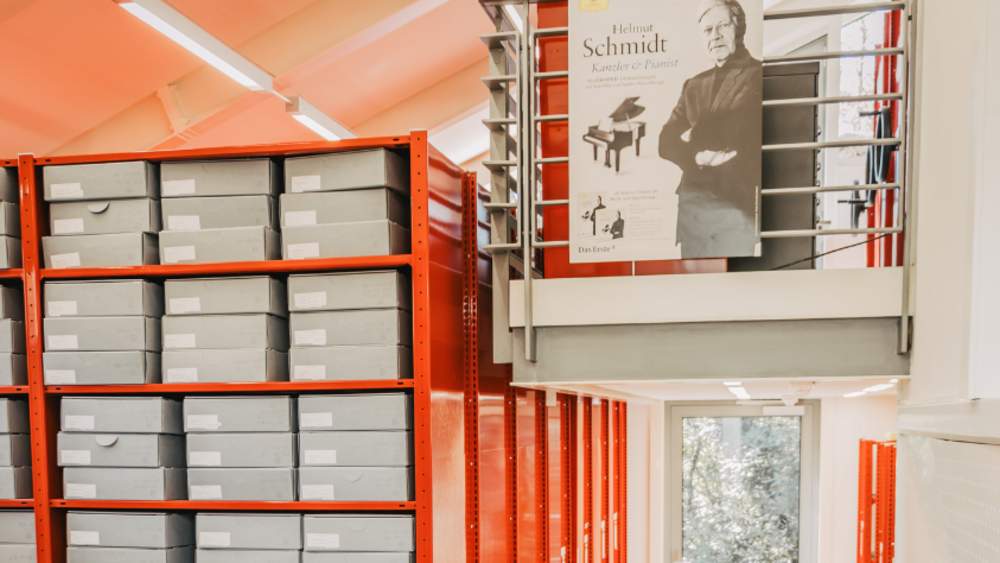
"History concerns every citizen," Helmut Schmidt warned in his speech at the 1978 Congress of Historians, adding that he realised that history was not only something to be mastered, but also something to be prepared for. The politician, publicist and elder statesman, who died at the age of 96, made a decisive contribution to this himself and set up a comprehensive private archive - today's Helmut Schmidt Archive (HSA). He had been collecting personal papers and family memorabilia since his earliest youth, much of which was burnt during the bombing of Hamburg in 1943.
Schmidt then began to file his memories and documents again, creating the basis of his now extensive archive. By the end of his life, the collection had grown to a total of around 3,500 folders. The surviving documents reflect the political discourse from the decades in which they were created and provide deep insights into the history of the Federal Republic of Germany, its transatlantic and other international connections, with a particular emphasis on European unification in the 20th century.
The HSA documents and preserves the decisions, actions and memories made by Schmidt and thus also functions as an archival repository and instrument for the rule of law and democracy. The former Chancellor was also aware of this historical significance for research and society. He therefore granted researchers and academics access to his documents during his lifetime and personally decreed that his private archive should be made accessible to the public independently of institutions and authorities.
The correspondence project
In accordance with Helmut Schmidt's wishes, his estate has been comprehensively catalogued and indexed since 2018. This is extensive pioneering work, as until 2017 only fragmentary finding aids existed that covered neither the breadth nor the depth of the entire collection.
An important focus of the cataloguing is Schmidt's private and political correspondence, who exchanged letters with more than 10,000 people around the world until his death. In view of his political significance, his work in various political, economic and cultural arenas and the large number of voices involved, the collection of letters is of extraordinary historical and social interest. Schmidt's correspondence partners included numerous influential personalities from politics, business, culture, religion and sport. In addition to exceptional individual items such as the letters from Pope Paul VI, King Juan Carlos and sportsman Dirk Nowitzki, the collection includes correspondence with Willy Brandt, Helmut Kohl, Karl Klasen and Hans-Dietrich Genscher that spanned decades. Correspondence with people who are relevant today also lend the collection a current relevance.
The correspondence project, which began in 2022 and will run until at least 2027, is dedicated to the archival cataloguing and indexing of these valuable sources. The aim of the project is to record the contents of the letters in the form of critical-historical registers, i.e. the communication of the facts and persons addressed in the letter, to digitise the originals in the interests of long-term preservation and to make them available for research and academic evaluation - in compliance with all applicable legal provisions.
What the letters reveal
Whether handwritten or typewritten, whether a private message or an official letter: Letters are extraordinary testimonies to history. They take many forms and fulfil many functions and provide valuable insights into political decisions and historical backgrounds. Schmidt's extensive collection of correspondence impressively documents the life and work of people in contemporary history and enables the reconstruction of global networks and everyday history. The letters are also the central link between the HSA and the Schmidt family home opposite. They make it possible to trace the origins of numerous objects from the physical estate - including works of art, books, coins and personal memorabilia. One example of this is the correspondence between Helmut Schmidt and his political rival Helmut Kohl, which began more than 50 years ago: In December 1983, Kohl sent his predecessor a handwritten birthday greeting including a gift - a small sculpture in the style of Henry Moore's sculpture "Large Two Forms", whose monumental bronze sculpture Schmidt had chosen for the forecourt of the Chancellery in Bonn in 1979. The letter not only documents the relationship between the two politicians, but also certifies the origin of the object, which is still kept in a display case in the residence.
As the correspondence continues to be analysed, it will become increasingly possible to conduct systematic provenance research on the approximately 10,000 objects in the private residence; in this way, connections and contexts of origin will be made visible.
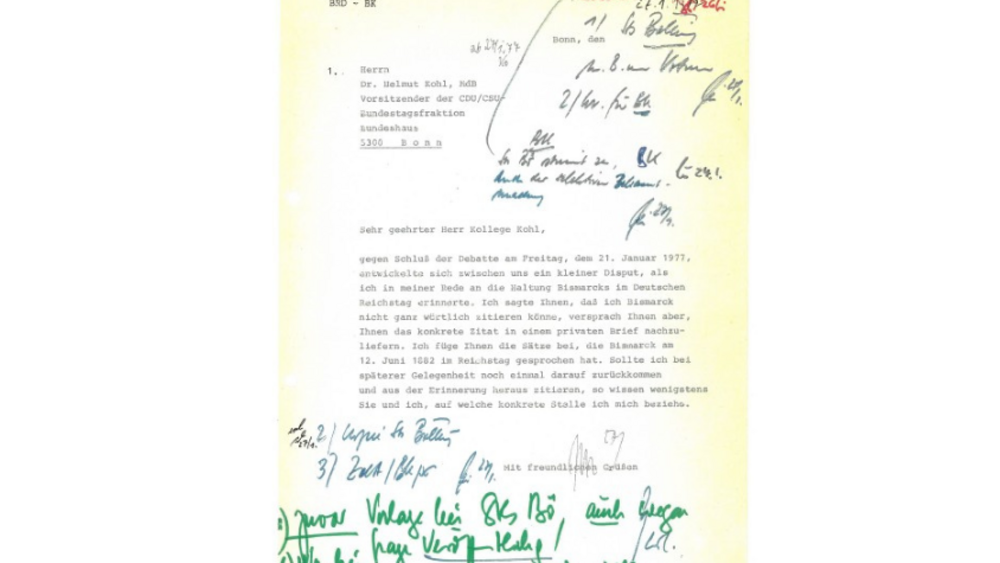
The surviving letters, which date back to the 1950s, also provide fascinating insights into Schmidt's working methods. Influenced by his work at the Ministry of Economics and Transport in Hamburg and the organisational requirements of his later political offices, his filing was based on the principles of official registries. Letters were initially organised and filed by year, later by quarter. Numerous handwritten notes, annotations, underlinings and paraphs not only document administrative procedures, but also provide insights into personal relationships, decision-making processes and political communication structures.
The value of the written word
Language and writing are one of the most important cultural achievements of mankind, providing information about epochs, cultures and societies through form and content. The extensive collection of letters in the HSA also provides information about Schmidt's private and professional life, general social conventions or individual emotions like hardly any other source and, through its two levels of observation, one of content and one of form, always raises the question of the connection between form and subject.
Please note: Due to the ongoing cataloguing of the letter collection, it will probably only be available to archive users to a limited extent until 2027.