
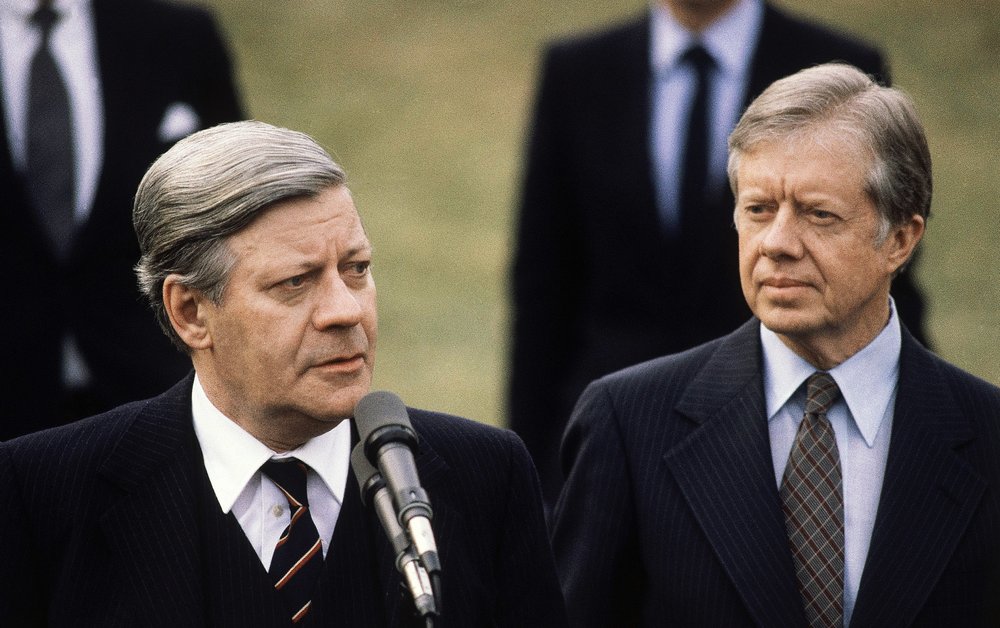
1 October 2024 marks the 100th birthday of James Earl "Jimmy" Carter. The 39th President of the United States held office from 1977 to 1981, during which time he had to overcome a series of serious crises together with his transatlantic partners. Contemporaries remember a difficult relationship with the then Federal Government under the leadership of Helmut Schmidt; however, historical research also agrees that the cooperation between the President and the Chancellor was characterised by numerous problems and misunderstandings.
In the mid-1970s, the German-American friendship was closer than perhaps ever before or since. US President Gerald Ford and Schmidt also know and appreciate each other privately; there is a great deal of agreement on key issues, as well as a trusting openness in which differences are discussed. However, Ford loses the election in November 1976 to the Democratic Party challenger Jimmy Carter. The son of a peanut farmer from Georgia, in the "Deep South" of the USA, is inexperienced in foreign policy - and he relies on a team of advisors who, unlike his predecessors, do not come from the think tanks of the US East Coast - where Schmidt has been well connected since the late 1950s and enjoys a high reputation in Washington D.C. overall.
Carter sets new priorities as President
For example, Carter wants to focus his foreign policy more strongly on respecting human rights, and in terms of security policy he is pushing ahead with negotiations on arms limitation (SALT II), as well as a lasting peace between Israel and the Arab world. However, the consequences of the oil price crises of the 1970s are severely limiting its room for manoeuvre, particularly in terms of economic policy. Here, the interests of the USA are to some extent different to those of Germany. The world's largest economy is less export-orientated, and government debt and rising inflation - also driven by high oil imports - are viewed less critically there. There are different positions on the measures to combat the crises, and this also applies to the issue of exporting sensitive nuclear technology. Germany had concluded supply agreements for nuclear power plants with Brazil, among others. The Carter administration takes a critical view of this. It fears that this will give more countries the ability to produce nuclear bombs. As a result, the German government decided against further deliveries.
When it came to the deployment of the so-called neutron bomb in the area of security policy, further serious disagreements arose: Schmidt, with great difficulty, campaigned within the SPD in favour of cooperation on the issue and negotiated a solution for the controversial weapons technology together with European partners. When Carter then stopped their production literally at the last minute for domestic political reasons, Schmidt felt exposed. The transatlantic relationship had to endure further tests in the aftermath of the Red Army's invasion of Afghanistan in December 1979. Germany saw the tough economic sanctions that the US administration wanted to impose as a less effective means; Schmidt was also only able to push through the USA's demand to boycott the 1980 Olympic Games in Moscow at a high domestic political cost.
Positive examples of joint action
Regardless of Carter's presidency, the relationship with the USA as a protecting power remained of central importance to Schmidt. Historical research places the various disagreements over important issues in a wider context. Since the early 1970s, the importance and weight of the USA on the global stage has been declining due to economic and, subsequently, monetary policy problems. The country has also lost political weight and credibility as a result of the lost war in Vietnam. Conversely, Germany has developed into a "stable middle power" since the 1950s and 1960s. The main reason for this is its booming economy and close integration into supranational institutions. As a result, a new self-confidence emerged, which in turn also became noticeable in its behaviour towards its most important ally. Schmidt in particular epitomises this attitude, which is viewed quite critically in the USA. The German government expects more consideration for its own interests and the special conditions under which political decisions are made: Coordination with the European states and here above all with France as the closest partner; the special challenges in connection with the "German question" as a result of the "Eastern treaties" negotiated under Willy Brandt's chancellorship. In this area in particular, Schmidt also had to take account of the interests within his own party, the SPD. After all, the "double decision" taken by NATO in 1979, which Schmidt was instrumental in promoting, was a crucial test for the Social Democrats.
Carter met the growing German self-confidence with less understanding than the Federal Government had hoped. Conversely, writes the historian and journalist Klaus Wiegrefe, Carter was met in Bonn with a "feeling of superiority" and the different economic policy priorities and interests of the two states were unilaterally associated with a lack of expertise on the part of the US administration. In this context, research also speaks of a growing insecurity in West German society since the end of the 1970s, combined with increasing anti-Americanism. On the other hand, "overconfidence, a lack of tact and exaggerated expectations" characterised US policy towards West Germany.
Carter and Schmidt: a lack of sympathy
In view of the major mutual coordination problems in various policy areas, the overall question arises as to what role the personal relationship between politicians plays. In the case of Carter and Schmidt, there was obviously a lack of sympathy and consequently also a lack of trust, one of the most important currencies in the political business. In addition to the complicated negotiation of bilateral interests, there are the necessary consultations with European partners - as well as numerous domestic political considerations, such as majority relationships in the US Congress and, in Germany, within government coalitions, in the Bundesrat or within the parties. Due to the different political systems, the chancellor and president each have a very different amount of power - in terms of democratic policy, the described need for coordination and "checks and balances" are part of the characteristics of democratically constituted states and ensure a distribution of power and influence.
Despite all the criticism in detail
The political balance sheet of Jimmy Carter's presidency on the 100th anniversary of his birth is certainly positive: No US soldiers lost their lives in the course of wars, the peace of Camp David between Egypt and Israel concluded under his aegis and the signing of the SALT II agreement (albeit not ratified by the US Congress as a result of the war in Afghanistan). After his presidency, Carter became involved in human rights issues and played an important role as a political mediator in various difficult missions. in 2002, he was awarded the Nobel Peace Prize for his commitment. And even in his old age, he and Helmut Schmidt were still in agreement in their assessment of international politics: both sharply criticised the invasion of Iraq by US troops in March 2003.