
The year 2026 begins under geopolitical conditions that leave little room for optimism. The intervention of the United States in Venezuela has shown how openly economic interests have now become part of geopolitical power projection. The rhetoric of American government representatives has made no secret of the fact that it is not just about political stability, but also about access to resources, investment opportunities and strategic levers of economic influence. This development is not an isolated case, but exemplifies a global economic order that is rapidly becoming politicised and militarised. Against this backdrop, the question for Europe and Germany is how economic security can be guaranteed under conditions of intense geo-economic rivalry without abandoning the foundations of an open order.
In recent years, political debates in Germany have mainly revolved around competitiveness, technological sovereignty and defence capabilities. But this perspective falls short. Economic power never unfolds its effects in an economic vacuum. It is embedded in societal expectations, social security, ecological transformation and the state’s strategic capacity to act. A successful concept of economic security must therefore take into account how closely economic performance, military-strategic logistics, social stability and ecological resilience are intertwined. Only the interplay of these dimensions will create the robustness that Germany needs in order to remain capable of acting under changing world market conditions.
Economic security as a European task
In recent years, the European Union has begun to address these interrelationships institutionally. The strategic framework was systematically defined once again in December 2025 with the European doctrine on economic security. It focuses on Europe’s ability to strengthen economic openness and competitiveness, reduce vulnerabilities and expand strategic cooperation with partners. Berlin is currently working in parallel on a national economic security strategy, which is due to be published this year. The fact that these debates are being held at all today is a direct consequence of recent crisis experiences: pandemic disruptions to global supply chains, geopolitical rivalry between major powers, energy shocks as a result of the Russian war of aggression and the instrumentalisation of economic dependencies by third countries.
This sheds new light on the understanding of economic interdependence. What was considered the foundation of prosperity for decades is increasingly becoming an area of economic and political vulnerability. Economic dependencies are being used as political leverage. This makes economic security all the more important as a goal: it is important to organise one’s own economy in such a way that it can remain open and efficient under conditions of strategic rivalry and at the same time is able to secure political and economic room for manoeuvre. The state plays a formative role in this. It coordinates, regulates, sets incentives, invests in critical infrastructure and defines strategic interests.
Ports as strategic hubs of economic security
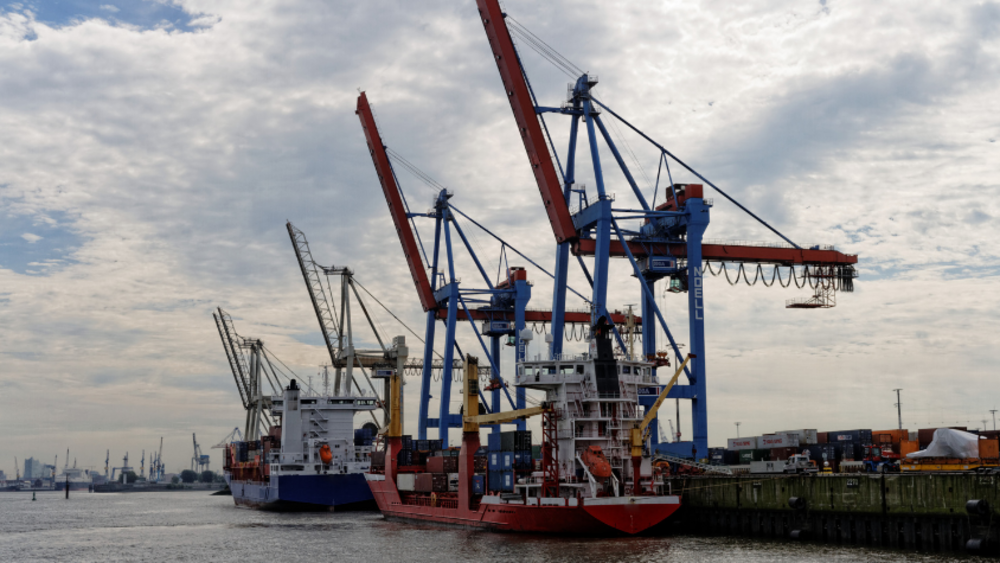
Few places illustrate the new logic of economic security as clearly as the Port of Hamburg. Ports are far more than just transhipment centres for global trade. They are logistical, security and social infrastructures at the same time. Industrial imports, energy supplies, utilities and security-related logistics all pass through them. For an export-orientated country like Germany in particular, ports are systemically relevant for economic performance, social stability and the ability to act politically.
In recent years, port policy has therefore experienced a remarkable reassessment in terms of security policy. With the National Security Strategy and the National Ports Strategy, the maritime dimension has been politically anchored. Cargo handling facilities have been classified as critical infrastructure, which has led to a reassessment of their role in security of supply, energy autonomy and military-strategic logistics. At the same time, the port is at the centre of geo-economic disputes. Today, foreign investments concern issues of strategic control, technological dependence and security-related influence. The port not only affects issues of efficiency and capacity in maritime competition, but also political, strategic and social factors. Its stability is therefore a benchmark for the (security) political and economic resilience of Germany as a business location as a whole.
The four dimensions of economic security in the Port of Hamburg
Our interviews with the port industry, trade unions and the political level as part of our research into inclusive geoeconomics show that the Port of Hamburg is a place where the current upheavals in the global economic order are particularly concentrated. Global shifts can be directly experienced here. Geopolitical tensions, trade conflicts and sanctions regimes are reflected in changing handling figures, new security requirements characterise operations and international crises have a direct impact on employees. At the same time, the port is a central arena for ecological transformation, where energy imports, emissions issues and investments in sustainable infrastructure converge.
From this perspective, the economic dimension of economic security takes centre stage. Competitiveness in the port is no longer defined solely by efficiency parameters, but by robustness, diversification and adaptability in the event of a crisis. The Port of Hamburg is particularly suitable in this respect because it not only handles containers, but also energy, bulk goods and industrial primary products, and therefore has a broader basis against external shocks. Its economic resilience is fuelled by the diversity and interlinking of handling types and industrial value chains.
At the same time, security policy functions are becoming increasingly important. Today, ports not only secure the prosperity of an economy, but also its ability to act in crises. If the movement of supply goods, energy, technology and military logistics is restricted, economic and industrial capacity is lost, as is political sovereignty. Concrete countermeasures therefore include military exercises as part of NATO and protection against cyber attacks. As a critical infrastructure, the Port of Hamburg demonstrates that the security policy dimension of economic security is no longer an abstract concept, but a practical prerequisite for strategic resilience.
At the same time, a third dimension is emerging in the port that has long been underestimated: the social dimension. Ports are major employers and therefore potentially places of social stabilisation. Collective bargaining structures, co-determination, training and security cushion transformation processes and create confidence in change. During the discussions, it became clear how important these factors are for the port’s ability to transform. Economic security can only be politically enforceable if it is socially supported. A port location understood purely in business terms may be efficient, but without social acceptance and social security it loses political legitimacy and erodes long-term stability.
A fourth dimension permeates all three of the above: the ecological dimension. Energy imports, emissions, land conversion and infrastructure reorganisation are tangible in the port. At the same time, the ecological transformation is linked to security of supply. The expansion of new energy infrastructures strengthens resilience and autonomy in the short term, but is in tension with long-term climate goals and the land conflicts with urban society resulting from the special location of the Port of Hamburg. The ecological question thus becomes inextricably social. Transformation can only succeed if it is supported by employees and local residents. The harbour is an example of how ecological sustainability is not merely a normative goal, but a strategic factor of economic security that influences innovation investments, infrastructure decisions and social acceptance.
Inclusive geoeconomics as a strategic approach
The example of the Port of Hamburg clearly shows that economic security cannot be achieved through sectoral measures, but only through close coordination between state actors, companies, trade unions, urban society and international partners. Efficiency gains alone do not generate resilience if ecological costs, social tensions or strategic vulnerabilities undermine the stability of the entire system. An inclusive geo-economy that combines efficiency and security with participation and sustainability thus becomes a prerequisite for a resilient economic order.
The BKHS Viewpoint #11 “Rethinking economic security: Hamburg as a safe haven for an inclusive geo-economy” by Dr Elisabeth Winter and Lea Holst is available online.
Further information on the BKHS project “Inclusive geoeconomics” can be found here.