
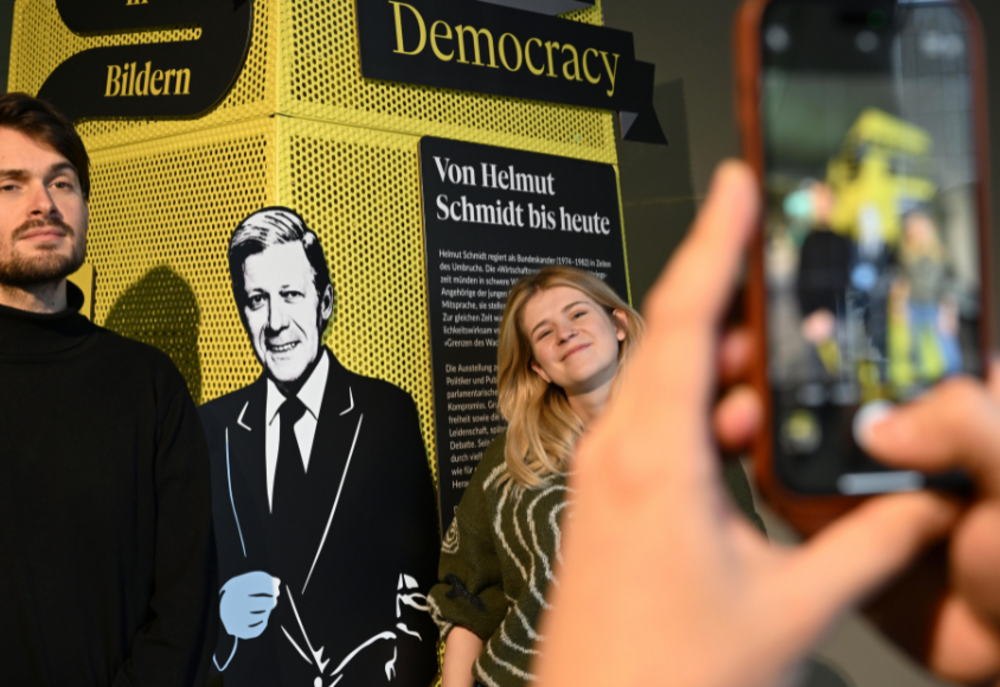
#Challenging Democracy is the title of our travelling exhibition. What is it about? One point of reference has been established - Helmut Schmidt. While some people experienced him as a chancellor and politician "out of office", for others he is merely a person of contemporary history with no closer connection. We wanted to design an exhibition that would arouse curiosity as you pass by, encourage people to think, call for participation and spark debate - with an extended supporting programme depending on the exhibition venue.
We will now be opening an exhibition that links current challenges with historical discourses in the Federal Republic of Germany from the late 1960s to the 1980s. The look at those involved, their means and approaches to solutions in the (security) political, economic, social and ecological debates enables an immersion in democratic processes in four modules. Schmidt and his contemporaries were confronted with similar questions to those we face today: What protects democracy? What threatens democracy? How social is democracy? How sustainable is democracy?
With knowledge about the historical debates in their luggage, the exhibition also asks you, our visitors: What do you think about these controversial issues? Interactive stations invite you to reflect, discuss and decide. #Challenging Democracy is changeable: the "Regional Window" deals with historical traces of Schmidt at the respective exhibition location. A biographical station shows important stages of Helmut Schmidt's private and political life. With a look behind the scenes of political staging, we explore the many Schmidt images that continue to have an impact today.
From "chambers of marvels" to the national house
A few hundred years ago, there would never have been an exhibition like this. Because in the "cabinets of curiosities", the forerunners of modern European museums, only invited guests were able to marvel at the personally collected artefacts of their noble owners: stuffed animals, art, ornate weapons or ingenious technology. They were used to demonstrate ownership and power. It was not until the Enlightenment, the French Revolution and the growing influence of the bourgeoisie that public, national museums were founded from the 19th century onwards. The objects in the collections were used for research, to explain the past, present and progress and to educate the public. They were presented in prestigious ornamental buildings as the artistic and cultural pride of the nation and created identity for the citizens. This process was reinforced by the exhibition of coveted cultural artefacts from other European countries as well as eye-catchers from regions of the world that were perceived as "exotic" and less developed from a contemporary perspective. In this way, the cosmopolitan curiosity of the educated middle-class museum public was satisfied without the need for an arduous journey, while at the same time strengthening the museum's own position by devaluing other concepts of identity and the world.
A museum is political
Today's museums are institutionally linked to this history of power, representation, identity and education. This is also visible in some listed museum buildings. The sovereignty of interpretation that continues to be publicly attributed to museums places responsibility in the hands of all those who shape this space.
What is a museum today? The term is not protected. The International Council of Museums (ICOM) formulates the main tasks of a museum in its definition: Collecting, preserving, researching, exhibiting and communicating - and even more: "Publicly accessible, barrier-free and inclusive, museums promote diversity and sustainability. They work and communicate with communities in an ethical, professional and participatory way. Museums enable diverse experiences in terms of education, enjoyment, reflection and knowledge exchange." The demands on institutions have therefore grown considerably: they should be places of experience for a diverse, heterogeneous and democratic society. What consequences does this have for cultural-historical institutions? The answers are as diverse as the demands placed on the institutions themselves and their employees.
#Challenging Democracy. From Helmut Schmidt to the present day
Our exhibition does not have a collection to preserve, it primarily brings together research, emphasises content, travels through Germany and will be on display at public, but not only classic exhibition venues. This is how I describe what it means to take on social responsibility as a historian and exhibition organiser: material is collected and researched behind the scenes. Based on these scientific findings, formats must be developed that offer points of contact for as many people as possible with their individual stories and create added educational value for them. Museums and exhibitions should open up democratic spaces for discourse and emphatically keep them open where others close them; provide differentiation where others play politics with populist statements. They encourage visitors to learn about history and, ideally, enable them to participate in society and politics. It is precisely with this in mind that we designed #Challenging Democracy and created a mobile space to learn about (historical) options for shaping a democracy and to incentivise people to help shape the present and future.
Curious? From 24 April to 16 May 2024, the exhibition will celebrate its premiere in the Paul Löbe House of the German Bundestag in Berlin, then it will travel to Bonn and Leipzig - and certainly soon to a location near you. Further information on the exhibition, opening hours in Berlin and the other venues can be found here. We look forward to your visit!