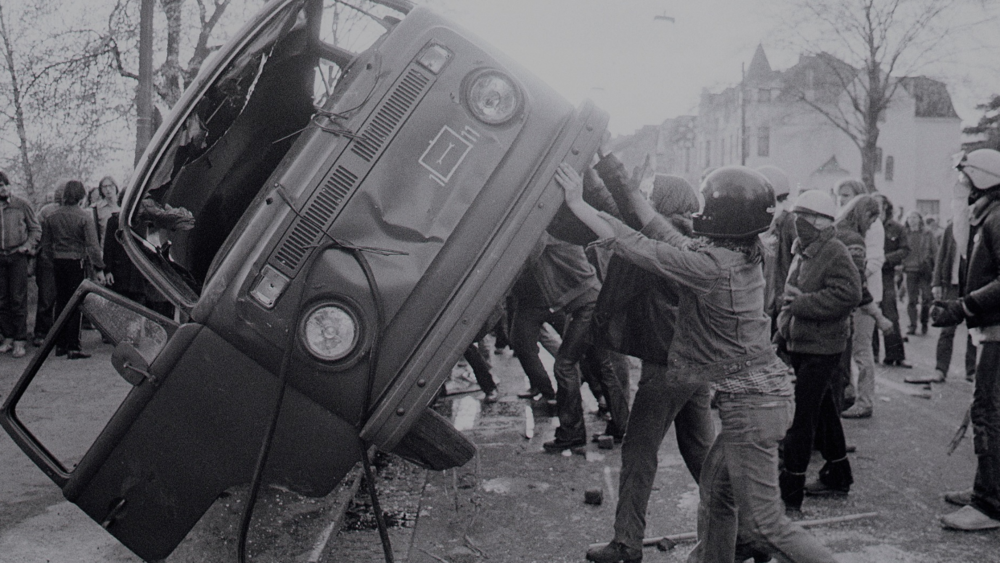
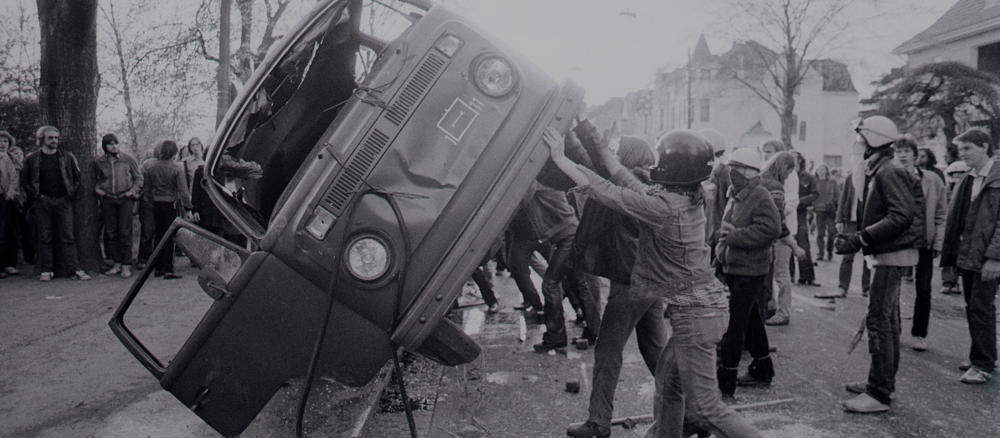
The CDU/CSU opposition to the social-liberal coalition in Bonn rubbed its hands with glee: In light of the riots that took place during the public swearing-in ceremony of 1,200 Bundeswehr recruits on 6 May 1980 in Bremen, the two party leaders, Helmut Kohl and Franz Josef Strauß, announced that there was “a coalition of action between the Young Socialists, the DGB Youth, IG Metall, ÖTV and the Communists”. The Jusos and “radical left-wing groups within the SPD” had called for the violent protests, about which Chancellor Helmut Schmidt, Defence Minister Hans Apel and the Bremen Senate, led by Mayor Hans Koschnick, had been warned in good time by the security services. The thrust of the press release was thus clear: all three politicians named and held to account were among the country’s leading Social Democrats.
The two-page statement by Kohl and Strauß – the latter of whom stood against Schmidt as the Union parties’ candidate for chancellor in the October 1980 federal election – went on to state, in pointed terms: “It is a scandal that the soldiers of our Bundeswehr need police protection. It is a scandal that soldiers and police officers are regarded as fair game by radical left-wingers. […] Chancellor Schmidt has so far remained silent on these events. […] Are more than 250 injured police officers and soldiers not enough to warrant a word of clarification and thanks from the Chancellor himself? Chancellor Schmidt remains silent because he lacks the strength and courage to stand up to the left-wing forces within his own party.”
Alfred Dregger, deputy chairman of the CDU and Member of the Bundestag, even went so far as to conclude in a separately published statement: “Schmidt cannot govern Germany”. Dregger, who was known as a representative of his party’s national-conservative wing and who called for the establishment of several parliamentary committees of inquiry to investigate the events, said verbatim: “The events in Bremen have starkly revealed that the Chancellor is a commander without troops and that the SPD has once again become a ‘leave-me-out-of-it’ party. German social democracy has proved incapable of adequately protecting our country’s internal and external peace and freedom in the current critical global situation.” According to Dregger, the extent of this ‘political failure’ was considerable, particularly in light of the Soviet Union’s invasion of Afghanistan (1979) and the accelerated deployment of SS-20 medium-range nuclear missiles in the Warsaw Pact states, which could destroy any location in Europe – not least West German cities. For this reason, Dregger criticised the riots during the Bundeswehr oath-taking ceremony not merely from a domestic political perspective; rather, he argued that they were also “of the utmost” significance in terms of foreign and security policy: “Under these circumstances, how is Moscow supposed to continue to believe in the Federal Republic of Germany’s defence readiness and defence capability? […] How are our Western allies supposed to continue to believe in the Federal Republic of Germany’s ability to fulfil its alliance obligations?’
A Wilhelmine-style field service or a declaration of loyalty by ‘citizens in uniform’?
In fact, several hundred people had been injured at the public swearing-in ceremony for recruits at Bremen’s Weserstadion; alongside the police officers and Bundeswehr soldiers positioned at the front by Dregger, there were also passers-by and peaceful demonstrators, who made up the majority. The oath, which was based on an idea by Hans Koschnick and coincided with the 25th anniversary of the Federal Republic’s accession to NATO, met with rejection from the DKP and the Communist League of West Germany, as well as from the peace movement, particularly as Federal President Karl Carstens, a former member of the NSDAP, took part. Even the SPD’s state chairman, Konrad Kunick, and the Social Democratic Working Group on Labour Issues criticised Koschnick’s decision, as did trade unions and Protestant pastors working in Bremen. From the perspective of Reinhard Schultz, deputy federal chairman of the Juso, the oath-taking ceremony was a ‘mass swearing-in in the form of a Wilhelmine field service’, which revived outdated traditional forms from Prussia’s days of splendour and glory.
For Helmut Schmidt, the attacks by Kohl, Strauß and Dregger were particularly hard to bear because – for the sake of the election campaign and with a delight in polemics – they challenged two of his central political maxims: Firstly, the image of soldiers as ‘citizens in uniform’ and the understanding of the Bundeswehr as a parliamentary army, in which the principle of ‘internal leadership’ must apply; and secondly, Schmidt’s advocacy of the NATO Double-Track Decision and the positioning of the Federal Republic as a reliable partner within the transatlantic defence alliance. On these fundamental convictions, the Chancellor found himself in agreement with Defence Minister Apel, who had attended the public swearing-in ceremony in Bremen. Both Social Democrats also disapproved of the opposition within their own party to the Bundeswehr oath. During a background discussion near Kiel in August 1980, Schmidt described the SPD’s situation in Bremen as ‘disgusting’ and dangerous.
No tomatoes for Franz Josef Strauß, or: against any form of violence
The very day after the recruits’ swearing-in ceremony, on 7 May 1980, Helmut Schmidt thanked the police and Bundeswehr soldiers for their efforts at an election campaign rally in Wuppertal and wished those injured a speedy recovery. He then placed the riots in the neighbourhoods around the Weserstadion – where full-scale street battles had broken out – within the broader context of freedom of demonstration and the prohibition on the use of violence: “I want to make one thing very clear here: Whether someone uses loud chants to prevent a political opponent from being heard, whether someone throws tomatoes at Mr Strauß, or whether they resort to violence in any other way: all of these are my enemies! They are enemies of German social democracy! We are democrats, and we abhor any form of violence against political opponents. Likewise, we abhor any violence in relations between states.”
The Federal Government’s official statement on the incidents in Bremen was similar in tone, albeit somewhat more statesmanlike. It went so far as to reaffirm the Bundeswehr’s role as an alliance army within NATO, with particular emphasis on the need to safeguard the balance in the policy of détente between West and East. On 8 September 1980, the parliamentary committee of inquiry, established by the German Bundestag on the initiative of the CDU/CSU, presented its final report. The Union parties were unable to translate their political aspirations directly into electoral success: Following the state election in North Rhine-Westphalia, which took place on 11 May – just five days after the oath – Johannes Rau (SPD) remained Minister-President – now even as head of a single-party Social Democratic government – and Schmidt was also able to retain his chancellorship in the 1980 federal election.
However, it was evident that the social-liberal coalition he led was in troubled waters. Whilst the FDP shifted towards an economically liberal course, resistance to Schmidt’s security policy grew amongst the Jusos and on the left wing of the SPD. It would take another two years before Helmut Kohl succeeded in his constructive vote of no confidence against the Chancellor on 1 October 1982, though this development was not entirely unexpected. As can be seen from the example of the riots that broke out during the swearing-in ceremony for new recruits in Bremen, Kohl and Strauß skilfully managed – much to Schmidt’s chagrin – to expose the SPD’s internal divisions on issues relating to the Bundeswehr and global security policy, and to capitalise politically on this.