
Fragile paper, files with cryptic signatures and thousands of books - that is what many people associate with the Helmut Schmidt Archive. But it is much more a place of living history. This is where the estates of Loki and Helmut Schmidt, his brother Wolfgang and Karl-Wilhelm Berkhan are kept and made accessible to researchers. The letters that Helmut Schmidt wrote and received throughout his life are a particular focus. In view of his political significance and his extensive work, they are of extraordinary social and historical value. This is because they contain statements about Schmidt's work, his personal assessments and information about important historical events.
Bright red shelves full of files are lined up in the Helmut Schmidt Archive, containing tens of thousands of Schmidt letters. In folder "936", two special letters fell into our hands during our research. They are from Helmut Schmidt and the German physicist and Nobel Prize winner Werner Heisenberg. It is probably one of the shortest exchanges of letters: two letters that deal with the difficult negotiations on the Eastern treaties and show how Helmut Schmidt left nothing to chance.
The "Action East Treaties"
On 17 May 1972, the majority of members of the Bundestag approved the Moscow Treaty with the Soviet Union and the Warsaw Treaty with Poland. However, the path to this was a major political challenge for the Bonn Republic and led the first cabinet under Chancellor Willy Brandt into a government crisis.
In the view of the first social-liberal coalition at federal level, the Eastern treaties were intended to create the basis for co-operation and peace in Europe, ensure détente between East and West and, above all, counteract the drifting apart of the two German states.
The ruling parties faced considerable political headwind from the opposition. They warned against the "sell-out of German interests", after all, millions of Germans had been expelled from their former Eastern European homeland after the end of the Second World War.
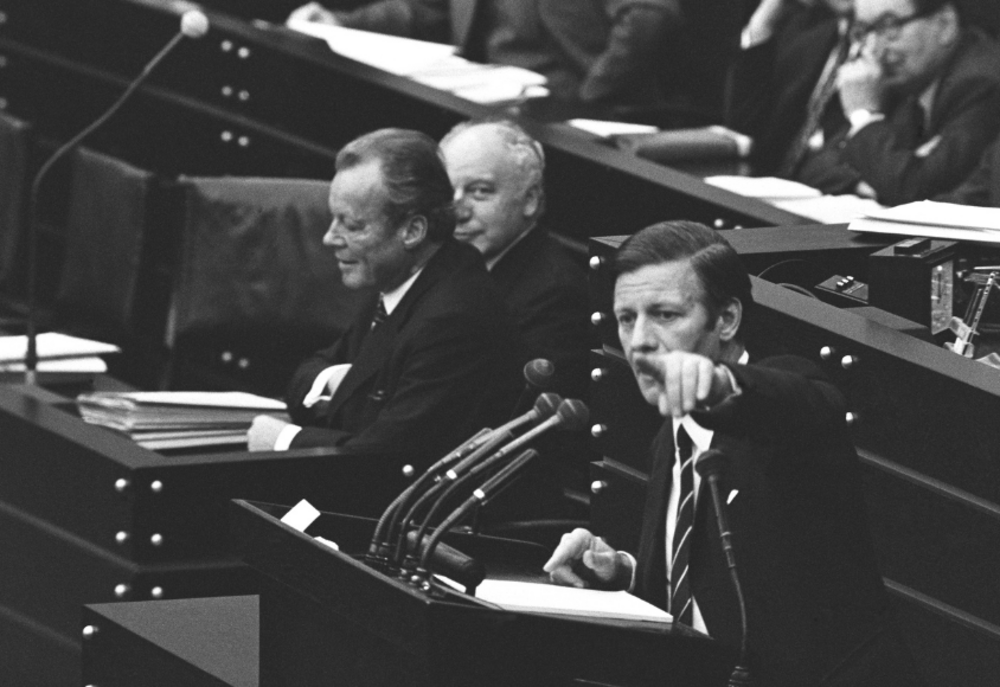
Schmidt, who was Minister of Defence at the time, had expressed "great concern" in the weeks beforehand "that the debate about the two Eastern treaties and thus also about the Berlin Agreement seems to be left exclusively to the exponents of the political parties". He considered it very important that not only his own nation, but also all neighbouring states could recognise that the treaties were wanted by a broad public. Schmidt therefore sought contact with Werner Heisenberg, whom he had met personally in mid-March 1972 at a dinner with the former Federal Minister of Education and Science Hans Leussink (non-party) and with whom he had exchanged views on the public discourse on the forthcoming treaties with Eastern Europe. As early as the beginning of the 1960s, the nuclear physicist had publicly spoken out in favour of a political opening towards Eastern Europe, and in his letter of 29 March 1972, Schmidt asked for his support: "It seems to me that the time has come for intellectual Germany to show which side it wants to throw its weight behind." According to Schmidt, he assumed "with great inner certainty" that the Moscow and Warsaw Treaties would materialise. However, it was important to him "that these treaties are not only brought about by a small majority of professional politicians, but that they are wanted by the people". Just one week later, a memorandum was submitted which Heisenberg hoped would be signed by important representatives of the scientific community.
Heisenberg's estate contains the corresponding file "Aktion Ostverträge" (Action East Treaties) - safely stored in the archives of the Max Planck Society. Among other things, it contains the memorandum addressed to the members of the Bundestag, which was in favour of ratifying the Eastern Treaties. In it, Heisenberg and other scientists such as Carl-Friedrich von Weizsäcker demanded that it was necessary in terms of foreign policy and that domestic political considerations had to take a back seat. The paper was published on 28 April 1972 and helped shape the public debate. In the meantime, however, the continuing criticism of the treaties led to a constructive vote of no confidence in Federal Chancellor Willy Brandt. After the vote failed by an extraordinarily narrow margin of just two votes, the coalition and opposition agreed on a compromise with regard to the treaties with the East that included the obligation to renounce the use of force, but not the determination of Germany's borders. On 17 May 1972, the Bundestag finally adopted both treaties.
When Schmidt gave an interim assessment to the SPD's leadership committees in Berlin three weeks after the official entry into force of these East German treaties, he recalled that foreign policy "had already been outlined [...] at the Dortmund Party Conference in 1966 in the direction in which we have now actually implemented it". And even if he was not directly part of the team of architects like Brandt, Bahr and Scheel, he unreservedly supported the social-liberal coalition's New Ostpolitik.
Archives are systemically relevant
The brief correspondence between Schmidt and Heisenberg provides a fascinating insight behind the scenes of power: into what happens away from the public eye and yet is politically decisive. The content shows that Schmidt was a strategic politician and had a keen sense of the prominence and public authority of individual scientists. Incidentally, Heisenberg and Schmidt never wrote to each other again after the "Aktion Ostverträge"; they had worked together successfully in certain situations.
Such correspondence always inevitably reveals further information: the scope, the official apparatus involved, letterheads rich in data, special stationery, handwritten notes, postmarks and drafts of letters from the Schmidt office.
Letters can be an instrument of political power. A glance at the literature reveals little about the seemingly unusual cooperation between the Minister of Defence Schmidt and the retired nuclear physicist on the "Eastern Treaties Campaign". One of the most important tasks of archives is to make it possible to reveal historical connections that no one remembers or knows about in the first place. It was only through the Helmut Schmidt Archive and the Max Planck Society Archive that we were able to make Schmidt and Heisenberg's joint actions comprehensible.