A fairer global economic system: it was nothing more and nothing less than this that, above all, united the countries of the ‘Global South’ (at that time also organised within the ‘G77’ alliance) with the North-South Summit in Cancún, Mexico – which remains to this day the only summit of its kind.
The meeting on 22 and 23 October 1981 marked the culmination of efforts by various organisations working to strike a balance between the interests of the economically more successful and the poorer nations. The initiative for the summit conference came from former Federal Chancellor Willy Brandt, Chairman of the North-South Commission, which had been founded in 1977. The so-called Brandt Report, published in 1980 and entitled ‘North-South: A Programme for Survival’, defined the balance between rich and poor as an existential issue for the social and economic future of the planet. It argued that a fairer ‘New International Economic Order’ was necessary, not least to secure lasting peace.
Twenty-two heads of state and government from around the world were invited to Cancún, half of whom came from industrialised nations and half from so-called developing and emerging economies. The agenda included issues relating to finance, trade and development policy, as well as energy and raw materials. The ‘Western’ states were represented, amongst others, by US President Ronald Reagan and British Prime Minister Margaret Thatcher. Federal Chancellor Helmut Schmidt had to withdraw due to illness and was represented by Foreign Minister and Vice-Chancellor Hans-Dietrich Genscher.
The summit yielded hardly any tangible results. The leading industrialised nations were not prepared to call the existing global economic system into question, certainly not during a severe global economic crisis that had set in following the second oil price shock at the start of the 1980s. Instead of regulation and redistribution in favour of poorer nations, Ronald Reagan called for a free-market economy and greater international free trade. He rejected Keynesian-inspired state intervention – as practised primarily by social democratic governments in Europe. Growth and prosperity, Reagan argued, would be achieved through the withdrawal of the state, which was to ease the burden on businesses through tax cuts and reduce expenditure through cuts to social spending. His policies – known collectively as ‘Reaganomics’ – epitomise the neoliberal shift at the start of the decade. However, during Reagan’s term in office, government spending and new borrowing in the US rose massively due to the enormous nuclear arms race. This, in turn, led to very high interest rates and plunged many countries of the ‘Global South’ into a severe debt crisis in the 1980s.
Chancellor Helmut Schmidt attempted to steer a middle course, but agreed with both Reagan and Thatcher that the structures of the Western-dominated global economic system – in particular the development and monetary policy institutions, the World Bank and the IMF – should not be tampered with. He advocated reforms, but insisted that the prosperity of the industrialised nations was necessary in order to provide financial support to the less developed countries. Schmidt also called on the communist-ruled industrialised states to engage more actively in development cooperation alongside the West. However, the Soviet Union rejected this proposal and did not attend the Cancún meeting. Meanwhile, the social-liberal coalition pursued development policy primarily as an active foreign trade policy, which was intended to serve both German exports and the securing of raw materials. Overall, the focus was on criteria relating to geopolitical and global economic stability.
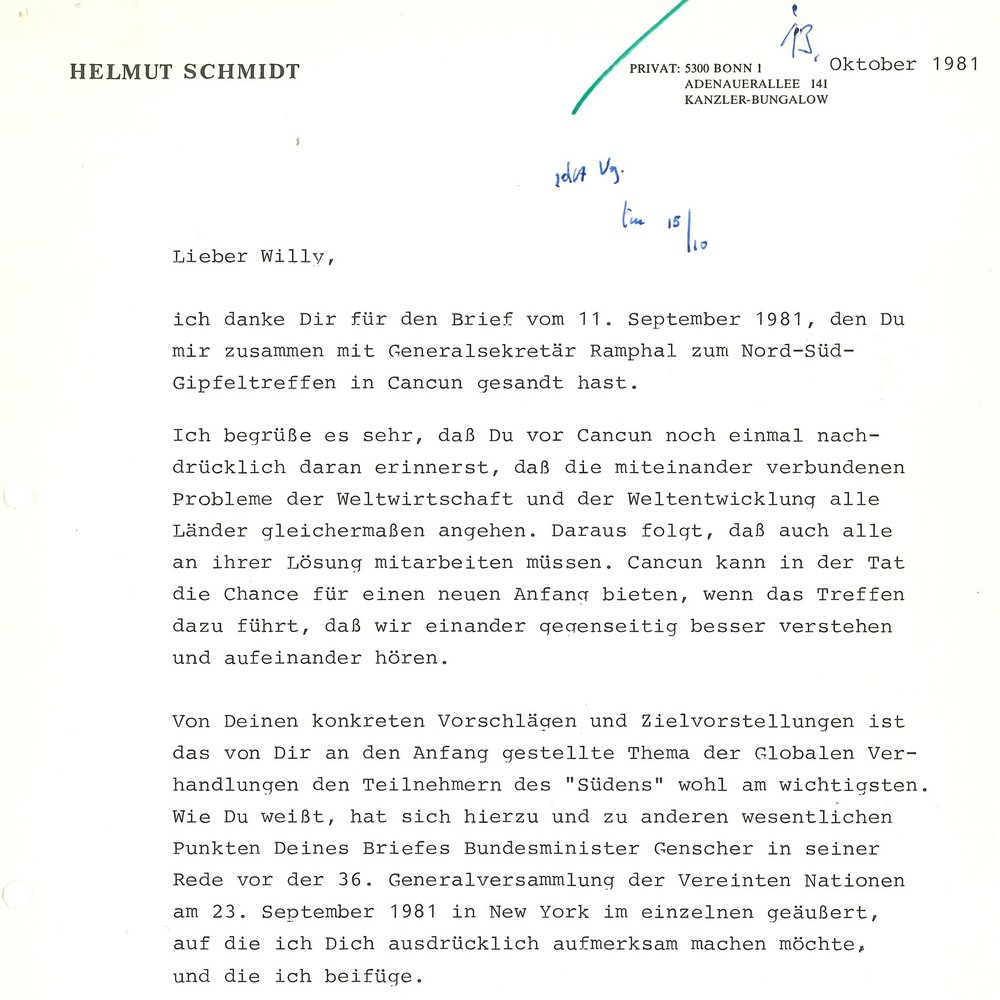
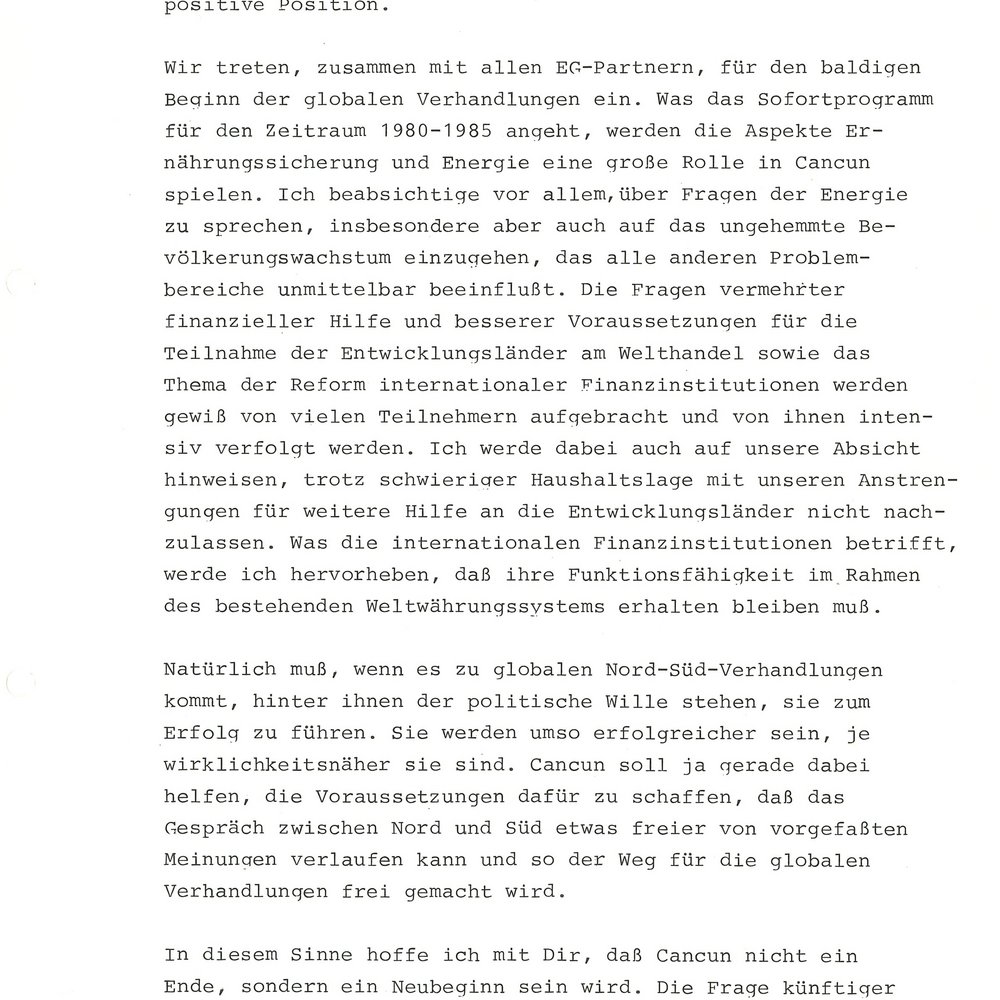
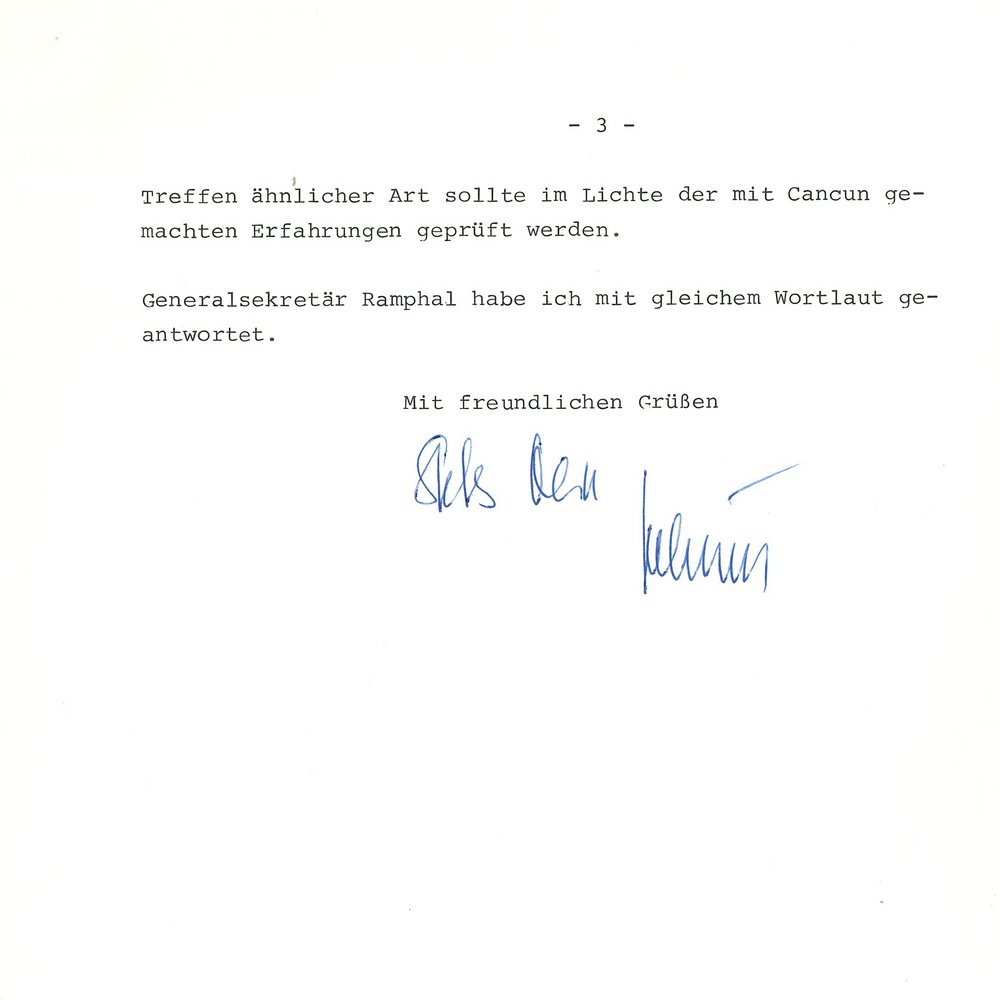
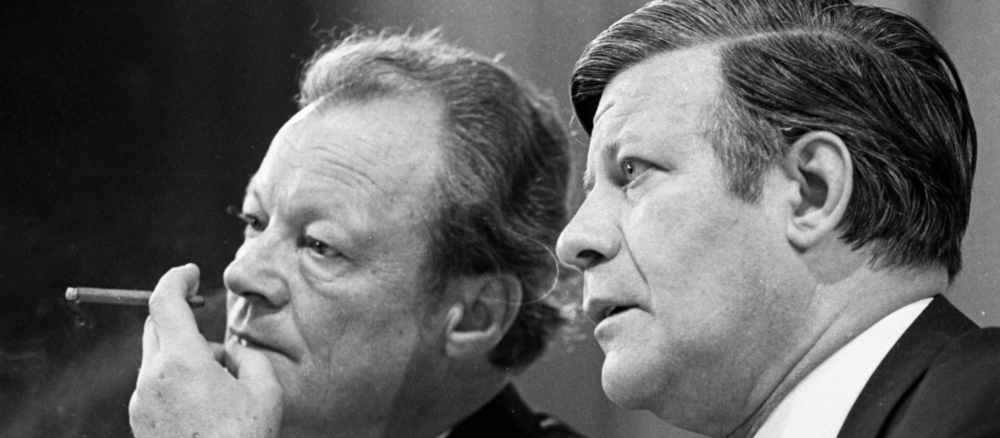
On a number of key points, Schmidt’s positions differed significantly from those of his predecessor, Brandt, who held no government office after 1974. Together with the majority of the G77 states, Willy Brandt called on the industrialised nations to massively increase development aid in order to effectively combat poverty and hunger worldwide. He also called for the removal of trade barriers and a fundamental reform of the World Bank and the IMF, which would give the countries of the ‘Global South’ a greater say. Nevertheless, the proposals put forward by his North-South Commission in the run-up to Cancún were also highly controversial. Hardliners within the G77 accused Brandt of being unwilling to challenge the foundations of an unjust global economic order. In an exchange of letters leading up to the summit, Brandt and Schmidt discussed their respective ideas and objectives regarding North-South policy. The cautious phrasing in the Chancellor’s letter of October 13, 1981, points to significant differences in their positions, as evidenced by the letter from Schmidt shown below.
Apart from formulaic compromises, declarations of intent and the positive atmosphere of the discussions (which was, in fact, praised by many), the summit ultimately achieved little. The reasons for this were not only the shift in priorities resulting from the aforementioned global economic crisis, but also the intensifying conflicts characterised by a ‘Second Cold War’ between the superpowers, the USA and the USSR. The agenda for a ‘New World Economic Order’ – which had at times offered more promising prospects for the countries of the ‘Global South’ during the period of growth in the 1960s and early 1970s – came to an end in Cancún.
Helmut Schmidt always maintained that fundamental problems could hardly ever be resolved at summit meetings – but that it was nevertheless important to keep the dialogue going, particularly to build or maintain trust through personal contact with other heads of government. In this way, doors could at least be kept open for the future. Looking at the conflicts and wars of the present day, this position sounds like a warning, yet putting it into practice is more difficult than ever. At the same time, looking back at Cancún in 1981 brings to mind today’s summit formats: Challenges relating to trade, industry or energy policy are usually decided primarily on the basis of geopolitical interests, with issues of (social) justice taking a back seat. What is needed are binding financing, implementation and monitoring mechanisms, to which the participants, however, hardly ever commit themselves.
Meanwhile, the picture of the ‘Global South’ has changed significantly since Cancún. Countries such as China and India, which were already represented by their heads of state in 1981, carry far greater weight today. The industrialised nations that were the most important at that time are no longer the only players on the stage. Many of the poorer countries, however, remain structurally dependent, and their problems therefore unchanged. This applies also, and in particular, to the fight against hunger: even back then, this was one of the most important items on the agenda for the North-South Commission.
If you are interested in the latest research on this topic, we recommend reading Christopher Seiberlich’s article in the new volume published by the BKHS and the Federal Chancellor Willy Brandt Foundation
Change of Chancellor 1974
From 19 November, you will find articles there on key issues surrounding the handover of office from Brandt to Schmidt: what significance did this have for foreign and security policy, economic and financial policy, and social policy? How did the personal relationship between the two leading Social Democrats influence practical government action? And what insights does an examination of the two chancellors’ legacy offer for assessing today’s politics?