
“Transatlantic relations and Europe’s capacity to act in a multipolar world”
Since the end of the Second World War, transatlantic relations have been based on a commitment to a fundamental community of values and interests, a long-standing security partnership, and a willingness to share global responsibility. This Western partnership, which has been repeatedly put to the test over recent decades, has now been emphatically abandoned under the second Trump administration. Changes in domestic policy that had been taking place for some time, increasing divergences in norms and interests, and shifts in regional priorities in US foreign policy were, admittedly, noted on the European side, but apparently not regarded as relevant in the long term or as posing a threat to relations. Consequences, such as the development of a truly independent and effective foreign, security and defence policy, were pursued and driven forward only slowly and more out of a need to adapt than with sufficient conviction.
Now, however – faced with a dual turning point comprising Russia’s war of aggression against Ukraine and a fundamental shift in the role of the US, including the abandonment of the rules-based liberal international order – relations between Europe and the US stand at a critical juncture and face unprecedented changes. The Trump administration’s policy of equidistance – verging on hostility towards the EU – its threats and interference even towards allies, its blatant breaches of international law, its closeness to autocrats whilst democracy and the rule of law in the US are eroding, as well as the repeated questioning of the long-established security partnership within NATO, are forcing Europeans to swiftly make up for lost ground and become capable of acting independently. This means being able to uphold and implement European values, interests and principles even when they are not supported by the US, or are even directly threatened by it.
Europe faces a complex challenge: it is necessary to completely rethink transatlantic relations; to maintain cooperation and interdependence where they remain functionally necessary or strategically sensible, whilst at the same time preserving the enormous substance of these relations wherever possible and where desired by both sides, without succumbing to the ‘principle of hope’ or illusions. At the same time, in view of the policies of the current US administration, the EU and its Member States must define red lines and prepare consistent responses; above all, however, they must finally think and act strategically and independently. This is not only a prerequisite for safeguarding its own political, economic and social sovereignty, but also for resilient partnerships, both transatlantic and international. In an increasingly post-Western world, the EU faces a particular challenge in defining an independent role in international politics in order to act credibly and successfully towards both old and new partners. To this end, transatlantic relations must also be realigned in the light of significantly changed circumstances.
The key questions are therefore:
- What are the changed conditions in transatlantic relations (at the international/systemic level, the state and bilateral levels, and the domestic level) – what is structural and long-term, and what is politically driven by ‘Trump’ or MAGA?
- How can this realignment be successfully achieved, and under what conditions can transatlantic relations remain sustainable (and how)? What can and should be preserved, even under changed circumstances?
- What forms of transatlantic cooperation are still possible, legitimate and strategically sound in the 21st century under these changed circumstances – and across which levels, actors and issues must they be organised in future?
- If the governmental level in the US partially fails or becomes unreliable, transatlantic relations must be conceived more broadly in societal and institutional terms.
- Or, to put it another way: if, in the light of political and societal developments, government-to-government relations at federal level are merely one frame of reference amongst others, do sub-national levels, civil society actors, and economic and academic networks then gain in importance? And how can these relationships be addressed and shaped in a positive way?
- What would the establishment of an EU capable of taking effective action (in foreign, security and defence policy, as well as global governance) and the pursuit of strategic autonomy, including economic and technological sovereignty, mean for transatlantic relations?
The ‘FOTAR 2026’ project addresses these questions and challenges in US-EU relations against a backdrop of fundamentally changed circumstances. It examines the future of transatlantic relations across three key thematic areas:
- ‘Peace, Security & the Future of NATO’
- ‘Democracy, Freedom & Society’
- ‘International Order, Sovereign Equality and (Climate) Justice in a Post-Western World’
FOTAR 2026 aims to provide an analytical assessment of the tensions described, the continuing interdependencies and the opportunities for cooperation. On this basis, the aim is to develop realistic, values-based and policy-relevant courses of action for European policy with regard to transatlantic relations.
Amanda Pridmore

Amanda Pridmore is a project manager at the Global Public Policy Institute (GPPi) in Berlin. She leads strategic communications for ENSURED, a consortium funded under ‘Horizon Europe’ that focuses on global governance and the future of European multilateralism. Her work focuses on the global order, strategic narratives and political communication, including research into the EU’s approach to multilateralism and the delivery of narrative training for the European External Action Service. Previously, she worked at the United States Holocaust Memorial Museum and spent time in Germany on a Fulbright scholarship, where she conducted research into narratives and the politics of memory. She holds degrees in Political Science and Philosophy from Clemson University and is about to complete her Master’s degree in International Relations at the Free University of Berlin, Humboldt University of Berlin and the University of Potsdam.
Ben Speggen
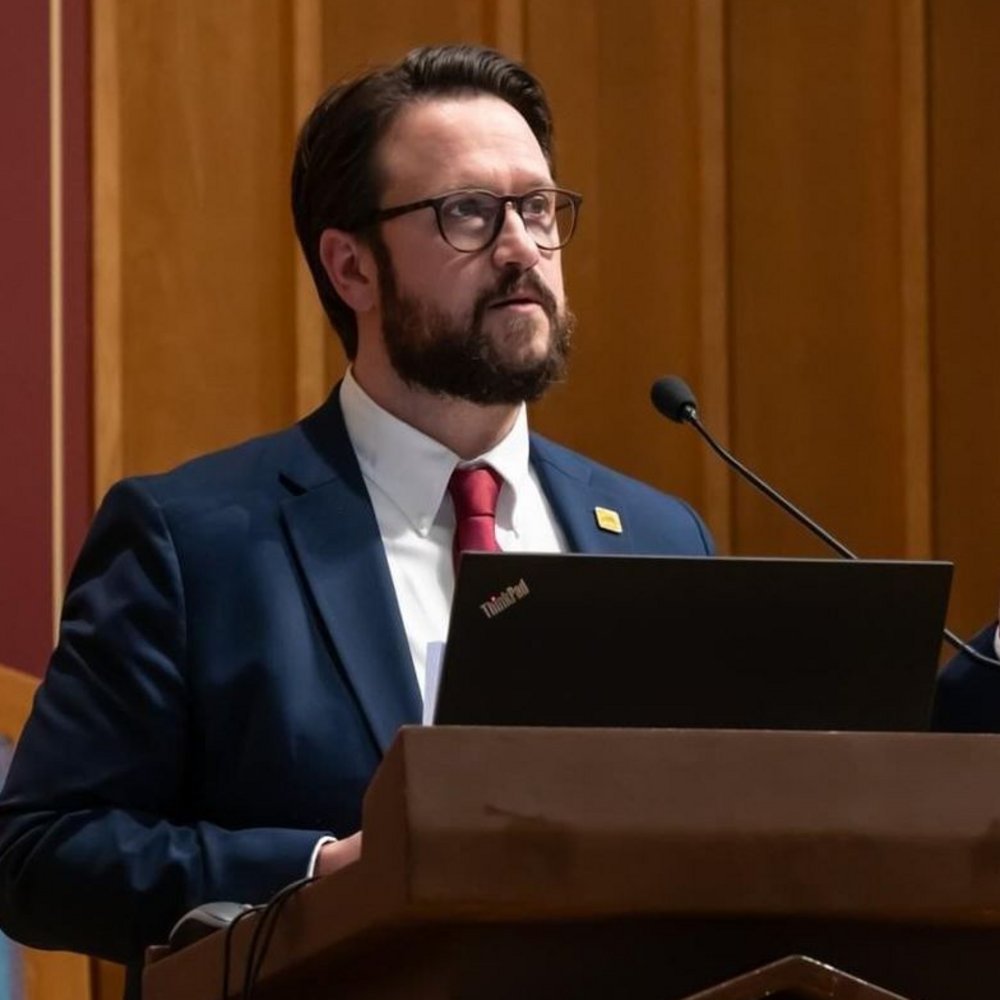
Ben Speggen is Vice-President of the Jefferson Educational Society, a non-partisan think tank based in Erie, Pennsylvania. He also works as an editor for the Erie Reader, a regional, independent alternative newspaper, which he helped to found in 2011 as executive editor-in-chief. He has also served as editorial director of the Our Towns Civic Foundation. He also presented a programme on local issues for public service broadcasting and taught writing and literature at a university. As the son of a miner and a care assistant, Ben was the first in his family to complete a degree. He obtained both his master’s and bachelor’s degrees from Gannon University, where he studied writing, literature, history and journalism.
Isolde Ruhdorfer

Isolde Ruhdorfer is a foreign affairs editor at the online magazine Krautreporter in Berlin. She studied Eastern European Studies in Cologne and Nizhny Novgorod. She is an IJP Fellow, a Sylke-Tempel Fellow and a Kellen Fellow. Her research to date has taken her to the USA, Israel/Palestine and Hungary, amongst other places. In her work, she seeks to illustrate to her readers how international politics relates to their lives. In her FOTAR project, she will be working with Jason Moyer to examine the future of NATO in Europe.
Jason Moyer

Jason C. Moyer is Programme Director for Foreign and Security Policy at the Heinrich Böll Foundation in Washington, DC. The programme focuses on strengthening transatlantic dialogue on issues such as global peace and security, climate security and human security. Previously, Jason worked as a programme officer for the Wilson Centre’s ‘Global Europe Programme’ and, before that, at the Centre for Transatlantic Relations at Johns Hopkins SAIS. He is the author of more than 50 articles on current transatlantic relations, with a particular focus on NATO, the EU as a security actor, hybrid warfare and Arctic geopolitics. He holds a Master’s degree in German and European Studies from the School of Foreign Service at Georgetown University. Before undertaking his Master’s degree, Jason spent two years teaching English in South Korea on behalf of the Korean Ministry of Education. He lives in Alexandria with his wife and their rescue dog, Nori.
Jonathan Lehrer

Jonathan Lehrer is Programme Manager for International Affairs at the Körber Foundation. Jonathan works for the ‘Körber Emerging Middle Powers Initiative’ and is editor of The Berlin Pulse, the Körber Foundation’s annual foreign policy publication. Before joining the Körber Foundation, Jonathan worked at Professional Briefing China.Table. He also gained professional experience at the Federal Foreign Office in Berlin, at the German Institute for International and Security Affairs (SWP) and in the German Bundestag. Jonathan holds a Master’s degree in International Relations from Dresden University of Technology and spent semesters abroad at Qingdao University and the Moscow State Institute of International Relations (MGIMO).
Nathalie Frisch

Nathalie Frisch, a FOTAR scholarship holder funded by the Federal Chancellor Helmut Schmidt Foundation and the European College Hamburg, focuses on the topics of the international order, (climate) justice and transatlantic relations. She is an LL.M. student at the USC Gould School of Law, specialising in business law. Her research focuses on international investment law, duties of conduct under international law and innovative financing mechanisms for climate protection.