
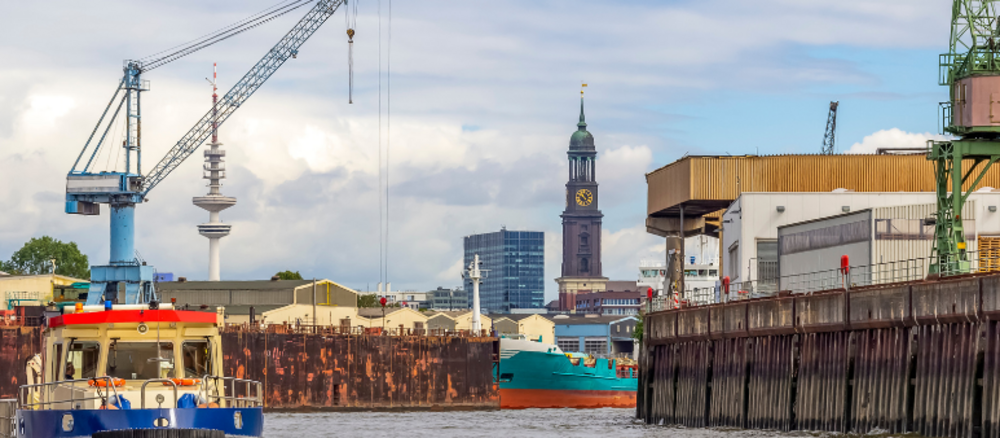
Economic security is high on the German and European agenda. With the publication of the new European doctrine on economic security last week, the debate on how Europe can remain open, competitive and at the same time resilient in a fragmented world is gaining further momentum. Our new policy paper "Rethinking economic security: Hamburg as a safe harbour of the inclusive geo-economy" presents a multi-dimensional approach to greater economic security for Germany and Europe.
Using the Port of Hamburg as an example, the policy paper shows how these dimensions interact in practice. The example makes it clear that ports are hubs of economic security and that long-term resilience can only be achieved through close cooperation between politics, business, trade unions and civil society.
The authors Dr Elisabeth Winter and Lea Holst argue that economic security goes far beyond competitiveness and defence capabilities. In a geopolitically fragmented world, economic dependencies, military risks, social tensions and ecological burdens are increasingly intertwined. This is why Germany needs an inclusive geo-economic strategy that systematically combines economic, strategic-military, social and ecological dimensions.
Key findings:
#1 Economic security is multidimensional.
Germany can only remain resilient and internationally competitive if economic, security policy, social and ecological dimensions are considered together.
#2 The EU sets the strategic framework.
The triad Promote - Protect - Partner, which was recently codified in the doctrine on economic security, should guide Germany's planned national economic security strategy.
#3 Ports are hubs of economic security.
The Port of Hamburg shows how closely economic-technological, strategic-military, social and environmental dimensions are intertwined, illustrating the need for close coordination between all relevant actors.
#4 Inclusive geo-economics is the key.
Economic policy must be actively shaped by linking efficiency, social inclusion and environmental sustainability.
Further information on the BKHS project Inclusive Geoeconomics can be found here