
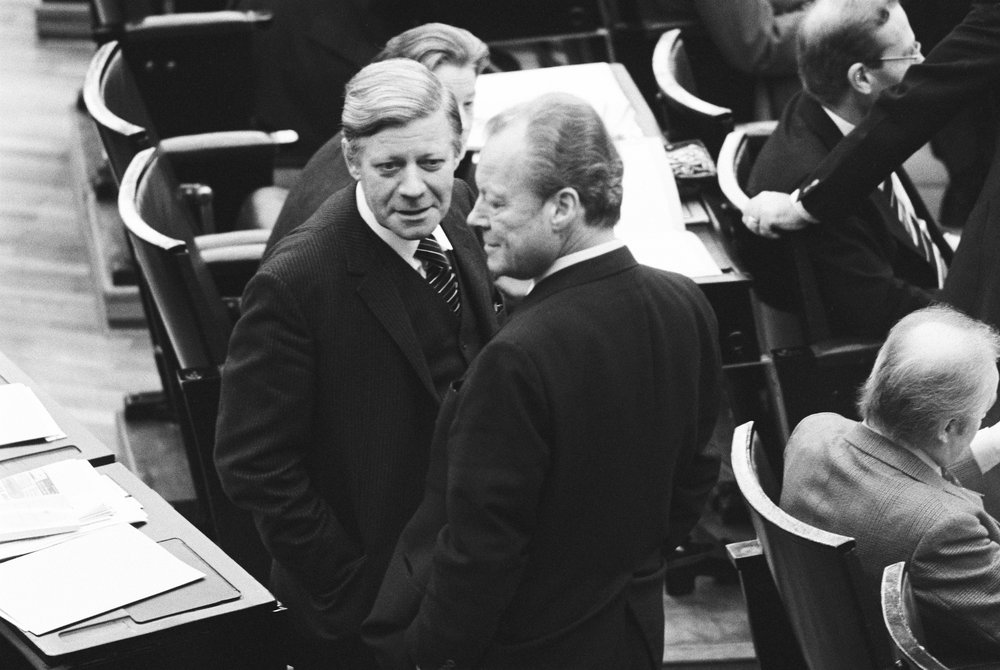
The change of Chancellor from Willy Brandt to Helmut Schmidt in May 1974, the 50th anniversary of which falls this year, was a time of upheaval. The collapse of the international monetary system and the oil price crisis in autumn 1973 marked the end of the decades-long post-war boom. High inflation rates, economic stagnation, wildcat strikes and a sharp rise in unemployment were the result. There was hardly any financial leeway left for the major reform projects of the social-liberal coalition. Much of the "planning euphoria" and optimistic belief in the future that had characterised Brandt's chancellorship since 1969 had evaporated. Instead, feelings of uncertainty, scepticism and fear of the future were spreading among large sections of the population. These concerns were fuelled not only by a growing awareness of the finite nature of natural resources and the pollution of the environment. Internal security also appeared to be under threat, which was shaken in the public perception above all by attacks by left-wing terrorist groups such as the Red Army Faction (RAF).
Emancipatory zeitgeist on the wane
Against this backdrop, support for the emancipatory zeitgeist that had gripped and changed the Federal Republic with the start of the student movement in 1967/68 declined noticeably at the time of the change of chancellor. At the same time, however, the 1970s also saw the development of a variety of "new social movements" that emerged from the left-wing alternative milieus of 1968: Sceptical of progress, environmentally aware and critical of capitalism, they countered the established representative democracy of the first post-war decades with a new understanding of politics - these movements were strongly developed not least within social democracy. In light of new scientific findings ("The Limits to Growth"), mostly well-educated young people questioned the traditional growth paradigm and thus old certainties. They called for new approaches, particularly in environmental and energy policy, but also with regard to gender issues, and later in security policy.
In this complex situation of upheaval, the signs of the times were primarily in favour of stability and security - in view of the widespread mood, there hardly seemed to be a more suitable successor than Helmut Schmidt. The graduate economist and former finance minister was an expert in economic and currency issues. And thanks to his diverse political experience and offices (Senator of the Interior in Hamburg, SPD parliamentary group leader in the Bundestag and Federal Minister of Defence), he had long been the hope and figurehead of his party for the future.
Stasi spy affair
Willy Brandt resigned as head of government on 6 May 1974 in the wake of the affair surrounding Stasi spy Günter Guillaume. The latter had been working as an advisor to the Chancellor and had been under observation by the police and the Office for the Protection of the Constitution for some time. Today there is widespread agreement that the exposure alone is not a sufficient reason for the resignation. Brandt's decision was rather due to the major challenges associated with the economic crisis as well as physical and mental exhaustion. He clearly no longer had the strength to cope with all this. Brandt resigned, but remained SPD chairman.
On 16 May 1974, Helmut Schmidt was elected the fifth Chancellor of the Federal Republic of Germany by the German Bundestag. He presented his programme to MPs one day later in his government statement under the motto "Continuity and concentration". He announced his intention to continue Brandt's agenda to a large extent, but emphasised that in times of difficult economic conditions, the reform process should be geared more towards fiscal opportunities. "At a time of growing global problems, we are focussing realistically and soberly on the essentials, on what is necessary now, and leaving other things to one side," said the new head of government.
"Partners and rivals"
Brandt and Schmidt had a complex personal relationship; they were "partners and rivals". On the one hand the socialist and opponent of National Socialism, on the other the air force officer who had served in Hitler's Wehrmacht throughout the war. The two were only five years apart in age. However, their experiences were very different and they thus represented two types of behaviour during the National Socialist dictatorship. Schmidt, who strongly distanced himself from National Socialism after the war, always held Brandt in high esteem because of his resistance and exile biography. From 1969 onwards, he increasingly clashed with his party colleague. This was mainly due to differing ideas about the leadership of the party and government. When Brandt finally resigned, Schmidt felt that he had not imposed himself on the chancellorship; an opinion that was shared by hardly any observers in Bonn at the time.
Change of Chancellor Conference
To mark the 50th anniversary, the BKHS and the Federal Chancellor Willy Brandt Foundation will discuss the many facets of the change of chancellor in 1974 at an international conference in Berlin and categorise them historically. This will also address the question of how the change of chancellor and the associated exchange of political personnel and content affected the (inter)national developments outlined above. We want to analyse this in the fields of foreign and security policy, economic and financial policy and social policy. At the same time, we will also take another critical look at the two personalities and their styles of government, scrutinising seemingly old certainties in the light of recent research - to this end, we have invited a number of experts from Germany and abroad. On the evening of the first day, 25 April, we will be joined by prominent guests from politics, academia and the media to discuss the history of the chancellors' impact for a broader audience and ask what conclusions can be drawn for the present. If you are interested in taking part in our conference, you can register here.