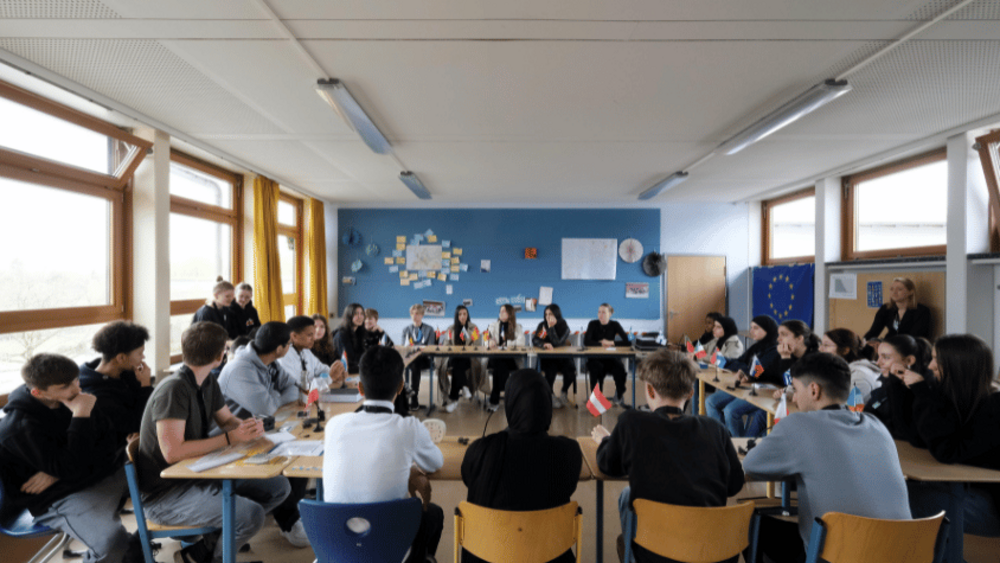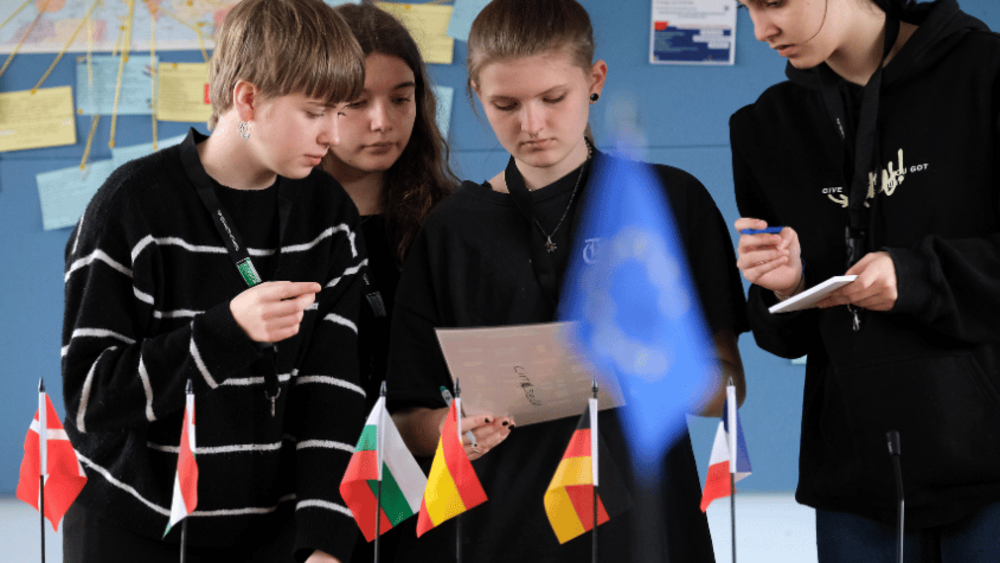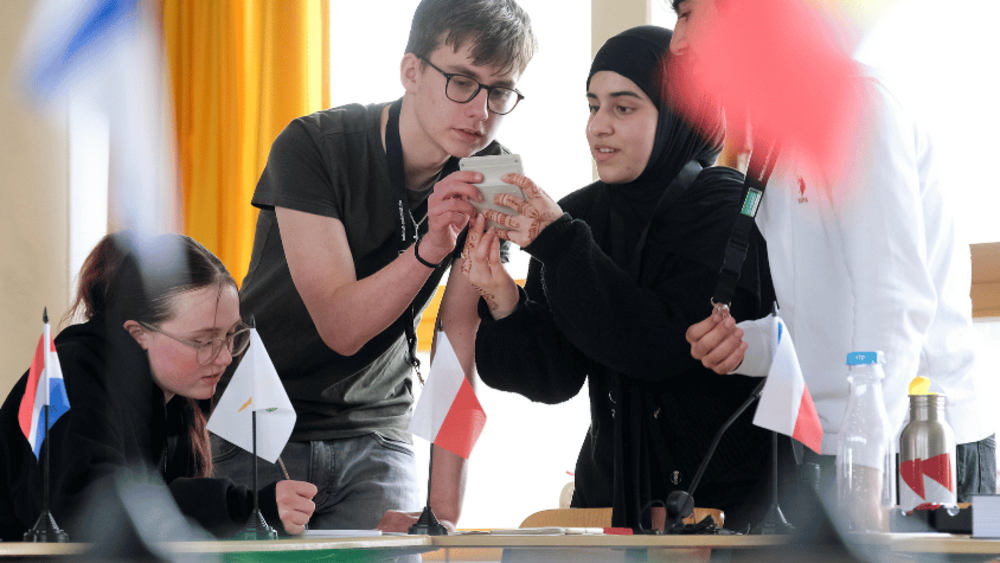
Thematic knowledge and practical skills for democratic coexistence - this is what our new game "Unlock Europe" conveys as an instrument of political education. The escape game provides a playful and low-threshold introduction to the EU as a peace project, security guarantor and community of values.
Escape games have been increasingly used in political education for a number of years. They always follow a similar principle: a group solves a main task within a given time frame with the help of clues that build on each other, for example by finding clues together, deciphering puzzles and cracking codes.
This makes escape games attractive for different target groups, as they promote group dynamics through the shared gaming experience and enable thematic learning and sensitisation effects. The shared puzzles serve as a starting point and motivation for further exploration of certain content afterwards. Each round of the game is followed by reflection and in-depth exploration of the content; the escape game method functions like a door opener.
As a target group-orientated format for political youth education, escape games are particularly suitable for use in a teaching context. Unlike simulation games or simulations, the participants do not take on external roles or represent pre-assigned positions, but remain themselves. This makes the format particularly suitable for creating a link to the participants' own real lives and connecting seemingly abstract political topics with very specific everyday issues. This is also the case with "Unlock Europe". In the game, participants encounter various aspects, questions and challenges relating to peace and security in Europe. For example, they deal with the causes and consequences of climate change or the importance of free trade and supply chains for the supply of essential goods.
Medicines for Timo's grandma, the threat of climate change
Participants not only learn about the political dimension of the topics addressed, but also meet fictional young people from Europe in the game who talk about the impact of the political situation on their everyday lives. For example, Timo, a young man from Austria, who is worried about his grandmother in hospital, who cannot be supplied with sufficient medication due to trade restrictions. Or Nayan and Nimra, two young people from Italy and Pakistan, who chat about the different consequences of climate change in the Global South and in Europe.
The aim is to convey a broader understanding of security and peace by relating it to the concrete realities of young people's lives in Europe: Security as a social value that does not only refer to the protection of life and limb or the defence of national borders by the military and police. Security also includes the preservation of an environment worth living in, the protection of critical infrastructure and the preservation of democratic values. Or peace, which is more than just the absence of war and armed violence. A positive understanding of peace goes beyond this and, as a process, aims to reduce structural violence and systematic inequalities and strengthen social justice in the long term.
Making joint decisions for the EU's future actions
Another aim of "Unlock Europe" is to make joint decisions on the EU's future actions. Participants come together as a whole group at a certain point in the game to choose between different options for action. To do this, they have to tell each other about the issues, aspects and problems they have learnt about, weigh up the pros and cons of the various measures and then decide together how the EU should act.
There is no right or wrong, rather the aim is to constructively include as many perspectives as possible and to find a common solution even in the case of differing or opposing positions. This can promote the participants' ability to make judgements and decisions as well as their self-efficacy - three important objectives in political education work with young people.
"Unlock Europe" can now be booked free of charge
Following the successful premiere of "Unlock Europe" at the end of April at the Helmut-Schmidt-Gymnasium in Hamburg-Wilhelmsburg, the escape game can now be booked free of charge for use in the Hamburg and northern Germany area. The Escape Game can be used in a classroom context, for example in a double lesson or as part of a project day at schools. However, it can also be used outside the school environment - in training centres, youth clubs or sports clubs.
"Unlock Europe" is aimed at young people aged 15 and over and can be played in groups of six to 30 people. Depending on the size of the group and their interests, they can choose between two and four topics:
- Security in trade and healthcare
- Climate security and the environment
- Diplomacy and border conflicts
- Digital security and democracy
A game run followed by a short reflection takes about 90 minutes. No prior knowledge of the content or technical requirements are necessary. The game takes place live and on site.
All the puzzles and props fit into a suitcase, so that the classroom or common room can be transformed into the scenario of the game in a few simple steps with the help of the game instructions. It is also possible to play "Unlock Europe" on the premises of the "Schmidt! Living Democracy" exhibition in Hamburg city centre.
Further information at: www.unlock-europe.de / Contact: