Our latest history product is now a year old: "#ChallengingDemocracy - From Helmut Schmidt to today" is touring the country in politically turbulent times. Four state elections and the Bundestag elections have seen the rise of forces that disregard the spirit and letter of the Basic Law. The AfD in particular is fuelling hatred towards social minorities and thus calling into question the first and central article of the German constitution: the protection of human dignity and thus also the basic consensus based on pluralism and tolerance. Especially in these times, we need spaces in which democratic and fact-based dialogue is possible to negotiate the future of society. As historians and historical-political educators, we have a responsibility to keep these spaces open and encourage people to actively participate. The non-partisanship of our foundation, which is enshrined in law, must not mean one thing: Neutrality towards those who attack the fundamental principles of our coexistence.
Space for fact-based dialogue and discussion
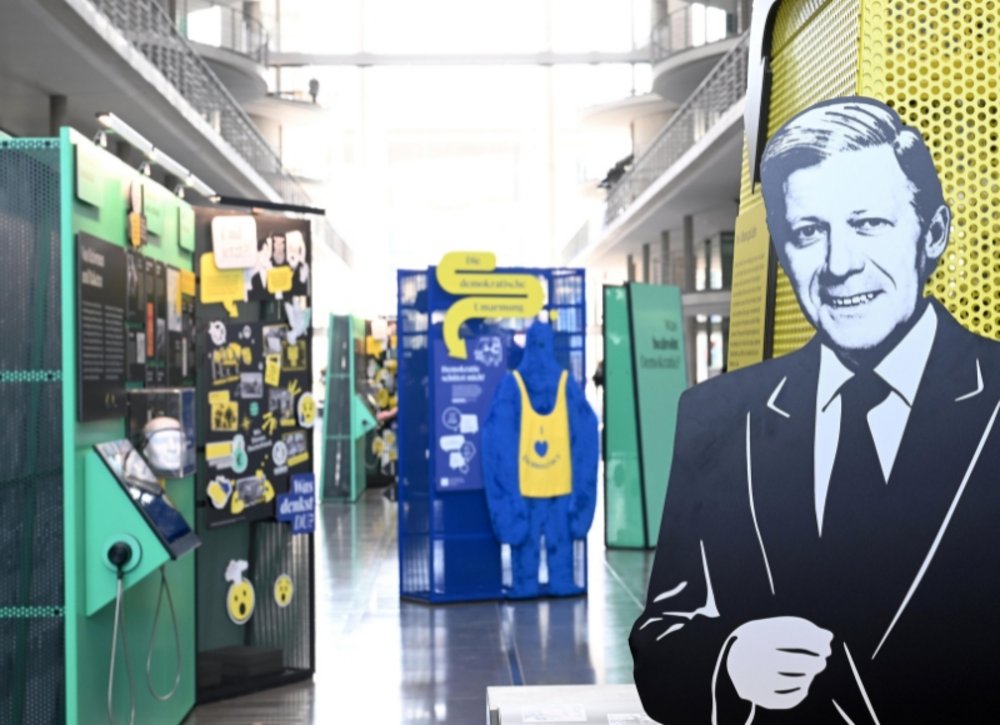
The travelling exhibition is intended to create such a space, even outside the foundation's home in Hamburg: "#ChallengingDemocracy" tells the story of German democracy. Starting with the person of Helmut Schmidt, we are focussing on important debates that moved people in the 1960s to 1980s. In doing so, we paint a picture of a multi-layered society in which political power is contained via checks and balances by civil society, an independent judiciary, academia, the media, interest groups and associations. What protects and what threatens democracy? How sustainable and how social is it? And what does this actually have to do with me? We pose these questions to both the past and the present and invite our guests to become active themselves at the interactive stations: Discussing, weighing up, taking a stand must be learnt and can be practised here.
We are all in demand
In conversations with people in the exhibition, through wish tree cards or from the guest book, we realise that many people are unsettled by the global situation and would like to see more stability, solutions and continuity in politics - and this is not only true for those who experienced Schmidt's work as a politician. Right-wing extremists and other actors who jeopardise democracy question the fundamental principles of democratically governed states: free elections without intimidation of the electorate or other manipulation, the separation of powers and, in particular, an independent judiciary, the principle of the rule of law and, last but not least, the facilitation of a peaceful transition of power. All of these points were central to Schmidt and thus, in our view, mark important positions in the context of an urgently needed demarcation between the political centre and authoritarian, extremist or even (religiously) fundamentalist forces. Whether in the Bundestag, with friends, in the supermarket or on the street: everyone is called upon to take responsibility for a social order that gives us the maximum amount of freedom.
Versatile supporting programme
Since the opening in Berlin in April 2024 in the German Bundestag, we have shown our exhibition in four other cities: Bonn, Leipzig, Rostock and Hanover. In May, the journey continues to Osnabrück, followed by Worms and Potsdam this year. According to well-founded estimates, we have reached over 7,500 people so far, people of diverse backgrounds, classes and education. The travelling exhibition is located in a wide variety of easily accessible public places: in town halls, libraries, museums, adult education centres and cultural and concert halls. In the supporting programme, consisting of public tours, an escape game, democracy talks, "Streitbars" and panel discussions, we take up the exhibition title and address current challenges to democracy. In Bonn and Hanover, for example, we talked about how to deal with anti-democratic actors - first with a view to the political and legal options and then very specifically in personal dealings in schools and cultural institutions. In Leipzig, the focus was on the question of what contribution more citizen participation can make to the future of democracy.
Wanted: local partners
Only together with local partners can we use the exhibition to enrich the political and cultural life of the respective region for a while. The constant change of location is both an opportunity and a challenge: finding out how we can offer added value on site from a distance is tedious, labour-intensive but extremely exciting. Getting to know committed people in different places who care about democracy and talking to them about their own present and future is also enriching on a personal level for us employees of the travelling exhibition. We try to utilise these constantly new perspectives to repeat the tried and tested at the next tour stops, but also to try out new things in order to provide impetus for strengthening our democracy.
We are still open to enquiries from cooperation partners for the coming years. Are you interested in showing the exhibition in your town or a town near you? Then please contact us at