
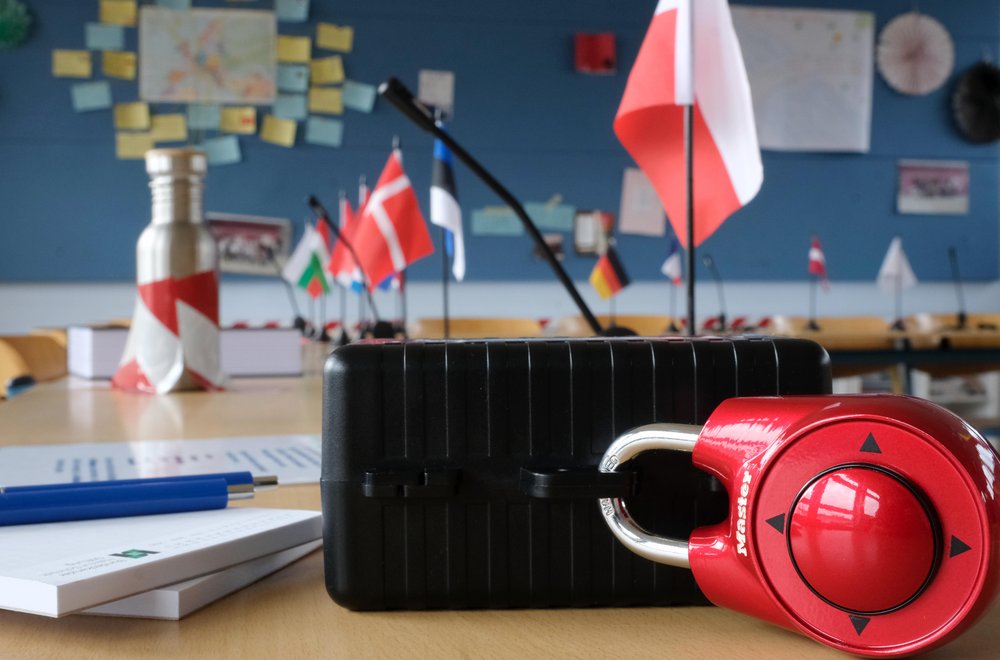
A red lock, an alarm clock without hands and a black hairbrush. On the table are small microphones and the flags of the EU member states. On the walls are a map of the EU single market, an overview of current exchange rates and information on international climate policy.
This is the setting in which the participants of "Unlock Europe - The Escape Game on Peace and Security" find themselves. The starting point is a fictitious scenario: a summit on pressing issues of European security and peace policy is being held at the European Council in Brussels. However, the heads of state and government who have travelled there suddenly get stuck in the lift. The participants must therefore step in to formulate the final declaration of the EU summit. The first task in the escape game is to get an overview of the available information and objects. Participants quickly find out what the hairbrush is all about, for example, by following the puzzling clues in the game. The initially seemingly chaotic mess in the strangely furnished EU meeting room makes more and more sense on closer inspection and by solving the puzzles together.
Learning through play
"Unlock Europe" is a playful programme for political (youth) education. It offers puzzle fun and imparts thematic knowledge on shaping peace and security in Europe. At the same time, participants practise important democratic skills by having to coordinate, agree, discuss and find compromises. As is usual with escape games, a group has to solve a task together within a given time frame and based on an imaginary story by finding clues, deciphering puzzles and cracking codes.
In "Unlock Europe", participants learn about political challenges in shaping peace and security in four areas: Trade and Healthcare, Climate and Environment, Diplomacy and Border Conflicts, and Democracy and Social Media. At the end, the group has to decide how the EU should act to tackle these challenges and problems. Players have to weigh up short and long-term solutions, European and global approaches or a neutral or partisan stance in interstate conflicts.
Since the launch of our escape game in April 2023, we have organised more than 120 rounds of the game with school classes and other groups such as students or young police candidates - in Hamburg and beyond. In just under two years, we have reached more than 2,500 people. Thanks to its design as a mobile suitcase version, "Unlock Europe" can also be played in other federal states. With the help of the manual and the step-by-step instructions, teachers can set up and run the game themselves on site.
Can political education be measured?
A short debriefing takes place after each game session, in which the participants give feedback on the game design, but also reflect on which topics, content and principles they have taken away or found particularly interesting. The playful format works like a door opener and is intended to encourage further engagement with the topics covered.
But does it really work? What do the participants take away from the escape game? Have they learnt anything and how do they rate working together as a group? In order to investigate these questions, we took a closer look at a number of game sessions in Hamburg last year and evaluated them with the help of short questionnaires.
Providing scientific evidence of learning effects and the impact of political education is complex and challenging, especially in the case of singular and limited learning formats such as our escape game. Learning is a long-term, multifactorial process and clear cause-and-effect relationships are difficult to establish and prove. In addition, our evaluation does not include a before-and-after comparison, as we only surveyed participants after they had played the game. Nevertheless, the responses of the 120 students surveyed provide an authentic and systematic impression of how the participants themselves assess the game format, the topics covered and the cooperation within the group.
What did we learn?
Overall, the feedback on "Unlock Europe" was positive. With two exceptions, the respondents were very satisfied or satisfied with the escape game and the debriefing. The underlying scenario of the EU summit and the politicians stuck in the lift was also rated positively (see figure). The vast majority of respondents either think the story makes them want to play the game (34 per cent) or find the story funny because it is so unrealistic (43 per cent). The remaining quarter liked the story less because it was unrealistic (8 per cent) or boring (9 per cent) or because they did not understand the story (3 per cent). These responses indicate that immersion in the fictional game context is successful overall - a key factor in the success of escape games. The scenario - as an introduction to the game - should clearly stand out from everyday school life or the usual workshop setting. The real world, typical roles or group constellations take a back seat.
More than three quarters of respondents answered in the affirmative when asked whether they felt that the escape game had taught them anything about peace, security and Europe. Around 70 per cent also stated that the escape game had made them curious to find out more about these topics. This impressively demonstrates the door-opening function of the format: the topics and challenges addressed invite people to engage further with the content and topics and to learn more about the significance, complexity and the many current references to EU security and peace policy. This is especially true in the times (and turning points) we are currently experiencing.
The cooperation in the group, the joint discussions and the exchange with each other were rated as very good by 57 per cent of respondents and good by 41 per cent. The question about the decision-making process at the end of the game, i.e. whether "Unlock Europe" helps to find compromises even when there are different opinions, was also answered positively by the majority (86 per cent in favour). However, some students also criticised the fact that they felt stressed by the time pressure in the game or would have liked more information (and time) for the final debate. These responses point to a general weakness of escape games: the time limit can prevent an in-depth discussion of the content (see here or here). The format can encourage further engagement and further learning effects. However, it should not be overloaded and overestimated in terms of learning content and objectives and should be deepened in the subsequent teaching unit.
How can target group-orientated political education succeed?
Our evaluation only offers a small insight. Given the number of cases and the focus on Hamburg schools, it is neither representative nor generalisable and is based on the pupils' self-assessments. Nevertheless, the results are an exciting orientation and an honest guide for continuing and further developing existing (youth) education formats. They can help to align thematic focuses and practical programmes closely with the interests, perspectives and needs of those who are to be reached. Only in this way can political education begin to have an impact at all.
You can read more about our experiences with "Unlock Europe" in the BKHS perspective "How young people think about peace and security in Europe".
You can find more information about the escape game at: www.unlock-europe.de
Would you like to book "Unlock Europe"? Then contact us by email at: