
Helmut Schmidt is said to have been sceptical about the work and output of the West German secret services, at least according to his biographer Hartmut Soell. In fact, even after his time in office, Schmidt was mostly monosyllabic about their work. According to Schmidt, his long-serving State Secretary Manfred Schüler, who was responsible for monitoring the services in the Chancellery, did this "superbly and silently".
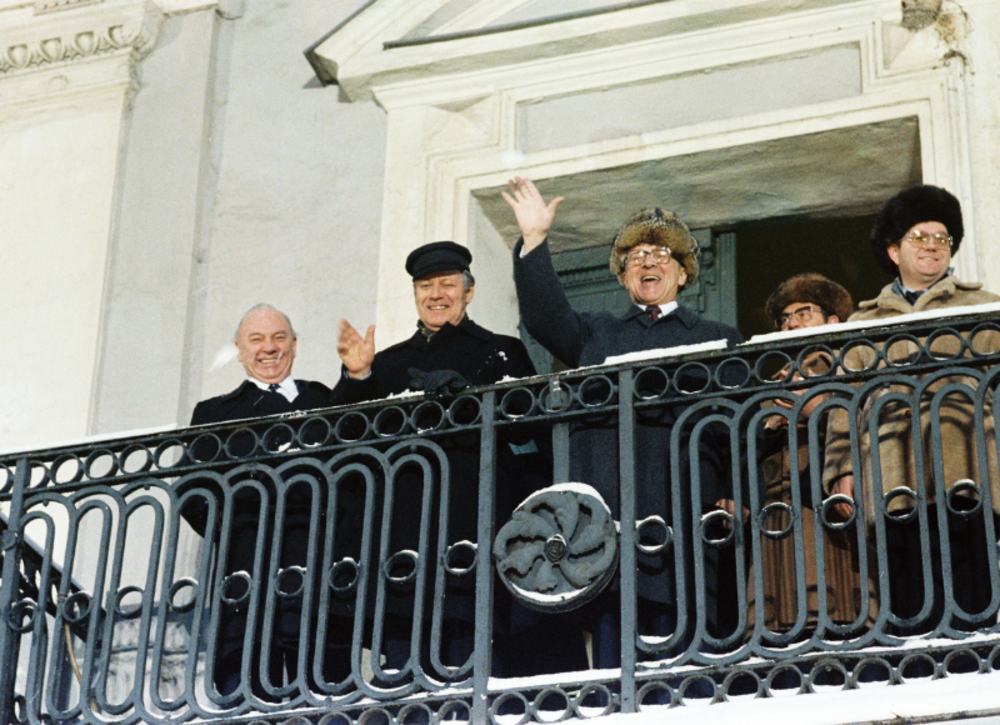
Schmidt also made few statements about the East German counterpart, the Ministry for State Security (MfS), usually abbreviated to "Stasi" - but he had to deal intensively with the repressive activities of the GDR secret service, which also had a huge impact on everyday political and social life in the Federal Republic. The beginning of Schmidt's chancellorship was directly linked to this: The Stasi, specifically the main department responsible for foreign affairs, had placed an agent, Günter Guillaume, in the immediate vicinity of Chancellor Willy Brandt - which he took as an opportunity to resign on 6 May 1974. It was not the first case of massive influence being exerted on German government policy. Even later, images and events remain linked to the powerful security apparatus. For example, the seemingly spooky scenes surrounding Helmut Schmidt's visit to Güstrow in Mecklenburg in December 1981, where the Stasi had turned an entire town into a backdrop for propaganda purposes.
A personal connection
The Stasi also kept extensive files on Helmut Schmidt. A copy of the historical documents is safely stored in his private archivein Hamburg-Langenhorn, while the originals can be found in the Stasi records archive. He had the MfS files on Schmidt handed over to him in 2007. They document that the Stasi had already begun collecting information about his political activities in 1965. This was initially limited to generally accessible information such as newspaper cuttings. From 1974 onwards, thematic research in the archives of the MfS led to the "Helmut Schmidt Cabinet 1974 to 1982" and also to numerous files relating to his political activities until 1989. For example, Schmidt is characterised in a dossier on the occasion of his chancellorship as a "pragmatic managerial type/ inclined to overestimate himself, twice a year he dresses 'off the rack' in Hamburg".
Helmut Schmidt was not only connected to the GDR on the political stage, but also in his private life. Helmut Walter, the first-born of Loki and Helmut Schmidt, died in February 1945, just seven months after his birth. He was buried in Bernau near Berlin, where the Schmidts lived at the time. When the inner-German borders were finally closed in 1961, they were unable to visit their son's grave. It was not until 1979 that Loki Schmidt, with the help of former SPD parliamentary group leader Herbert Wehner, GDR negotiator Wolfgang Vogel and the responsible pastor Nobert Lautenschläger, located the grave site again and had it restored. The Schmidts visited their child's grave whenever they could while travelling in the GDR.
Political responsibility
It was not only as Federal Chancellor that Schmidt worked to normalise relations between the two German states during the Cold War. In order to minimise the personal suffering of people - on both sides of the inner-German border - his government campaigned for easier travel, for example by reducing the so-called forced exchange. Together with the aforementioned special representative of the GDR government, Wolfgang Vogel, Schmidt also promoted the release of political prisoners held by the Stasi in its prisons. The "deal" with the SED state on this and other issues followed a pragmatic approach. Almost 34,000 people were freed and allowed to travel to West Germany. After 1989, Vogel admitted that he had also worked as an unofficial Stasi collaborator. At the same time, he had to defend himself against accusations of taking advantage. In his books, Schmidt repeatedly put himself before Vogel and argued in his favour that anyone who worked at the highest level for the good of the people would always have to make compromises.
This was based on Schmidt's perennial admonition: "You can only understand others if you listen to them!". This is just as true today as it was at the time of the division of Germany. While lines of conflict between the new and old federal states are now being discussed boldly in talk shows, we must not forget to look and listen carefully, because the history of the GDR and the Stasi is an all-German history. This shared past is also shown in the travelling exhibition "Alles Wissen Wollen".
The travelling exhibition about the work of the Stasi at the Helmut Schmidt Forum
The effects of the Stasi crimes are still present for people more than 35 years after the end of the GDR. Last year alone, around 20,000 people submitted initial applications to view the files of the Stasi Records Archive. A good reason to bring the travelling exhibition "Wanting to Know Everything. The Stasi and its documents" to Hamburg. It can be seen at the Helmut Schmidt Forum from 17 July to 3 September. The exhibition presents objects from the archive, provides information about the history of the GDR secret police and its methods as well as the often drastic consequences of spying on those affected. A reference to Helmut Schmidt's chancellorship is illustrated, among other things, by a Stasi planning map that was produced to monitor Schmidt's aforementioned visit to the GDR in Güstrow in 1981. Those affected and interested can enquire on the evening of the opening and also on the day after about the possibilities of inspecting their own Stasi files or those of family members. We look forward to your visit!